
2026 Guide: STEM Vendors for Singapore Primary Schools

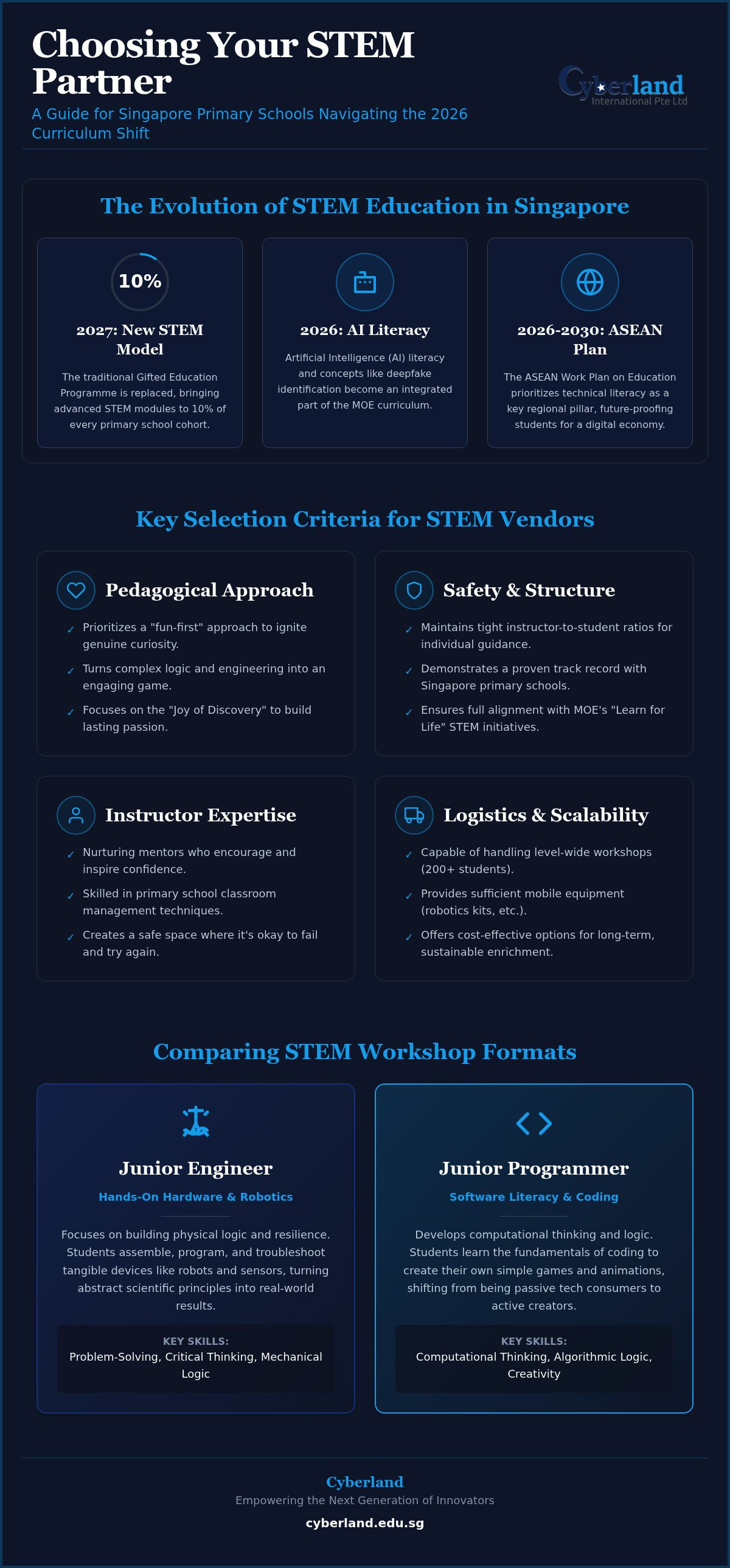
By 2027, the traditional Gifted Education Programme will be gone, replaced by a model that brings advanced STEM modules to 10% of every primary school cohort. This massive shift, alongside the 2026 integration of AI literacy into the MOE curriculum, means finding the right STEM vendors for primary schools Singapore is now a top priority. It's a crowded market. You've likely felt the frustration of programs that don't quite align with school goals or the logistical strain of managing external teams. We understand. You want workshops that spark genuine wonder, not just fill a time slot.
Finding a partner who understands the "Joy of Discovery" while meeting rigorous MOE standards is the key to lasting student interest. This guide will show you how to evaluate providers to ensure high-impact, seamless integration with your school’s schedule. We'll explore the latest 2026 trends, from AI literacy updates to the ASEAN Work Plan on Education. You're about to discover how to transform technical instruction into an inspiring journey for every student, whether they are exploring Junior Programmer modules or hands-on Junior Engineer projects.
Table of Contents
The Evolution of STEM Education in Singapore Primary Schools
The classroom is changing. Fast. In 2026, the Singapore education landscape has shifted its focus toward the 2026 to 2030 ASEAN Work Plan on Education. This plan prioritizes AI and technical literacy as regional pillars. For local primary schools, this means the Applied Learning Programme (ALP) is no longer just an extra activity. It's the heartbeat of a child’s development. Schools are moving away from dusty textbooks. They're embracing hands-on workshops that spark curiosity. This is where STEM vendors for primary schools Singapore play a vital role. They bring in specialized equipment like high-end robotics kits and coding platforms that schools might not keep on-site. They turn a standard science lesson into a laboratory of discovery. It's about future-proofing students for a digital economy that moves at the speed of light.
Aligning with MOE Standards
The Ministry of Education (MOE) continues to champion the "Learn for Life" initiative. It’s about more than grades. It’s about building a foundation for the future. External partners help bridge the gap between abstract theory and real-world application. When students see a sensor they’ve programmed react to light, the science becomes real. It's sensory. It's exciting. Specialized vendors ensure this curriculum is age-appropriate. They tailor complex concepts like AI literacy and deepfake identification into lessons that Primary 3 students can grasp. This alignment ensures that every workshop supports the school’s broader educational goals while staying current with 2026 curriculum updates.
The Growing Demand for Creative Problem Solvers
Engineering isn't just for adults anymore. Logic and computational thinking are becoming core primary school skills. We want our children to move from being passive consumers of technology to active creators. They shouldn't just play games; they should understand the logic behind them. This shift builds resilience. When a robot doesn't move as expected, the student must troubleshoot. They must think. This process is essential for Critical Thinking for Early Learners: Building Success. By introducing these challenges early, we prepare them for a digital economy that values innovation over rote memorization. It’s a journey from "what" to "how" and "why."
Selection Criteria for STEM Vendors in Singapore
Choosing the right educational partner is a big decision. It's about finding a team that shares your school's vision for growth. When evaluating STEM vendors for primary schools Singapore, the first thing to look at is their pedagogical heart. Is the program purely academic, or does it prioritize the joy of discovery? For younger learners, a "fun-first" approach is essential. It turns complex logic into a game. It makes engineering feel like play. This engagement is what keeps students coming back for more. It ignites a passion that lasts long after the workshop ends.
Safety and structure are equally vital. You need to know that instructor-to-student ratios are tight enough to ensure every child gets the guidance they deserve. A proven track record with other local schools provides peace of mind. It shows the vendor understands the unique rhythm of the Singaporean school year. By aligning with the Ministry of Education's STEM initiatives, these partners ensure their workshops complement what happens in the classroom. This synergy creates a holistic learning environment that supports every student's journey.
Evaluating Instructor Expertise
Technical skills are just the baseline. What really matters is how an instructor connects with a child. You want mentors who are nurturing and encouraging. They should be experts in primary school classroom management. It's about creating a safe space where it's okay to fail and try again. This uplifting approach in teaching sparks confidence. It turns a "can't do" into a "let's try." If you're looking for this kind of supportive environment, consider partnering with a reliable expert who understands these developmental milestones and knows how to inspire young minds.
Logistics and Scalability
Can the vendor handle a level-wide workshop for 200 students? This is a crucial question for school leaders. You need to know if they have enough mobile equipment to transform a hall into a tech hub. Scalability matters. A good vendor provides cost-effective options for long-term enrichment, ensuring that high-quality STEM education isn't just a one-off event. It should be a sustainable part of your school's culture. Look for providers who offer flexible setups that don't require permanent lab space. This flexibility makes it easier to fit impactful learning into busy school schedules without logistical headaches.
Comparing STEM Workshop Formats: Which Fits Your School?
Every student learns differently. Some find inspiration in the click of a plastic gear; others find it in the successful run of a complex script. When evaluating STEM vendors for primary schools Singapore, it’s essential to match the workshop format to your specific learning objectives. The goal isn't just to teach a skill. It’s to ignite a lifelong passion for discovery. By offering a variety of formats, you ensure every child finds a way to shine. Whether it's through physical construction or digital logic, the right format creates a bridge between curiosity and competence.
Modern STEM education is built on four distinct pillars that cater to different developmental milestones. Robotics workshops are fantastic for building physical machines and understanding the logic required to move them. Coding focuses heavily on software literacy and computational thinking. Engineering workshops emphasize hands-on construction and structural problem-solving. Finally, integrated STEM programs combine these disciplines for a holistic experience. Research from the National Institute of Education emphasizes the importance of a systemic STEM Learning Ecosystem to ensure students develop a deep, research-backed foundation in these areas.
The Junior Engineer vs. Junior Programmer Approach
Choosing between these two paths depends on whether you want to prioritize the "body" or the "mind" of technology. Junior Engineer is perfect for builders. It focuses on physical structures, gears, and motors. It’s tactile. It’s about spatial awareness and mechanical logic. On the other hand, Junior Programmer dives into the digital realm. It’s about sequences, loops, and invisible commands. If your school wants to strengthen digital literacy, our Junior Programmer Course Singapore: 2026 Parent Guide offers a great look at how these logic skills develop over time. Both paths are vital; they simply approach problem-solving from different angles.
STEMtastic: The Multi-Disciplinary Workshop
Sometimes, variety is the best teacher. Our STEMtastic workshops are designed as modular experiences that keep students engaged across different levels. Instead of sticking to one theme for the entire year, students rotate through different STEM challenges. This variety prevents burnout and keeps the sense of wonder alive. It creates a "Wonder and Possibility" atmosphere where every new session feels like a fresh adventure. This multi-disciplinary approach reflects the real world, where engineers, programmers, and designers must work together to solve complex problems. It’s about building a broad, sturdy foundation for the future.
Implementing STEM Workshops: A Step-by-Step for Schools
Success begins with clarity. Before engaging STEM vendors for primary schools Singapore, you must define your "why." Are you looking for a high-energy post-exam activity to celebrate the end of a semester? Or do you need a structured Co-Curricular Activity (CCA) that builds skills over several months? Knowing this helps you filter partners who specialize in either one-off wonder or long-term development. Once your goals are set, budgeting usually follows through GeBIZ or specific school funds. It’s a methodical process, but it's necessary to ensure every dollar spent translates into student growth.
Preparation is the secret sauce. Walk through your venue early. Ensure power points are accessible for robotics kits and that the Wi-Fi can handle thirty tablets at once. Coordinate with your vendor to align their arrival with your school's bell schedule. These small logistical details prevent headaches on the day of the workshop. After the session, don't just pack up. Collect student feedback. Ask them what surprised them. This data is gold for planning your next level-wide event. It helps you see which themes resonated most with your specific cohort.
Managing the Procurement Process
A clear vendor brief is your best friend. Be specific about your student cohort size and any special learning needs. When reviewing proposals, look beyond the price tag. Check for comprehensive Risk Assessment and Management System (RAMS) documents. Safety is non-negotiable in a primary school environment. You want a partner who respects your security protocols as much as they love teaching technology. If you need a partner who values this level of professional detail, explore our school partnership options to see how we simplify the process for you.
Measuring Success and Engagement
How do you know it worked? Look for the "Spark of Discovery." It’s that moment a student’s eyes widen because their code finally worked. Track interest levels with a simple pre- and post-workshop poll. Did their confidence in science improve? Use these outcomes to shape the future of your Applied Learning Programme (ALP). By documenting these wins, you build a strong case for continued STEM investment. This ensures your students remain at the forefront of the digital economy while enjoying the journey of learning.
Partnering with Cyberland: Empowering the Next Generation
Cyberland isn't just another name on a vendor list. We're a dedicated partner in your students' long-term success. From our central hub in Ang Mo Kio, we provide comprehensive support to schools across Singapore. We bring the specialized tools and the teaching talent directly to your classrooms. Our mission is clear. We want to nurture the next generation of Singaporean innovators. We achieve this through our highly successful signature modules. The Junior Engineer program invites students to master the physical world through construction. The Junior Programmer module empowers them to command the digital realm through logic. For level-wide flexibility, our STEMtastic workshops provide a customizable experience that adapts to any primary school cohort. We understand the unique needs of local educators. We're here to make your job easier while making their learning more impactful.
Our Pedagogical Philosophy
Our philosophy is built on wonder. We strike a careful balance between professional educational authority and a nurturing, warm atmosphere. We don't just deliver technical instruction. We ignite a child's natural curiosity. For learners aged 4 to 12, this is a critical developmental window. It's the time when they shift from asking "what is this?" to exploring "how can I build this?" This mindset is the core of our STEM Enrichment Programs in Singapore: A Parent’s 2026 Guide. We want every student to feel like a bold innovator. By focusing on growth and the joy of discovery, we help them build a positive trajectory for their future academic journeys.
Start Your Partnership Journey
Let’s start a conversation about your school’s future. Starting your partnership journey is simple and transparent. We invite you to experience our programs through a live demo. This allows your department to see the "Spark of Discovery" in action before committing. We collaborate closely with school leaders to design tailored enrichment programs. These programs align perfectly with your specific Applied Learning Programme (ALP) goals. Whether you need a high-impact post-exam activity or a structured, long-term CCA, we adapt to your schedule. We're more than just STEM vendors for primary schools Singapore; we're your allies in education. Partner with Cyberland to ignite your students’ curiosity today and let’s shape the future together.
Shaping Future Innovators Together
The 2026 educational landscape is brimming with wonder and potential. With AI literacy and advanced modules now central to the primary experience, your choice of partners has never been more vital for student success. You've seen how the right STEM vendors for primary schools Singapore can transform a standard hall into a vibrant hub of logic and discovery. It's about finding that perfect synergy between rigorous MOE alignment and the pure, unadulterated joy of learning. Every workshop is an opportunity to build resilience and ignite a lifelong passion.
Cyberland is proud to be a trusted partner for preschools and primary schools across the island. Our specialized Junior Engineer and Junior Programmer curriculum is meticulously crafted to ignite that essential spark in every young learner. From our home base in Ang Mo Kio, we're ready to provide the local, hands-on support your school needs to excel. Let's move beyond the limits of textbooks. Let's build, code, and innovate together. This is the positive trajectory your students deserve.
Partner with Cyberland for your school’s 2026 STEM programs and witness your students' confidence reach new heights. The future belongs to the curious, and we're here to guide them every step of the way.
Frequently Asked Questions
What should I look for in a STEM vendor for a Singapore primary school?
Look for a partner that balances technical expertise with a nurturing pedagogical approach. You want STEM vendors for primary schools Singapore that prioritize the joy of discovery over rote learning. It's essential to check for a proven track record within the local school system. Ensure they provide age-appropriate materials and maintain high safety standards. A vendor that understands the 2026 MOE curriculum shifts will offer the best support for your students.
Are Cyberland workshops aligned with the MOE Science and Math curriculum?
Yes, our programs are specifically designed to complement the MOE Science and Math syllabus. We bridge the gap between theoretical classroom concepts and real-world application. Our Junior Programmer and Junior Engineer modules use hands-on logic to reinforce what students learn in their textbooks. We stay updated with the latest 2026 curriculum changes, including AI literacy and digital wellness. This ensures every session supports your school’s broader educational goals and academic excellence.
Can STEM workshops be customized for different primary school levels (P1-P6)?
Absolutely. We believe in providing the right challenge at the right time. Our workshops are highly modular and can be tailored for every level from Primary 1 to Primary 6. For younger students, we focus on tactile exploration and basic logic. For older cohorts, we dive deeper into complex coding sequences and engineering problem-solving. This customization ensures that every child, regardless of their starting point, feels inspired and capable of mastering new technical skills.
What is the ideal student-to-instructor ratio for a coding workshop?
We recommend a tight ratio to ensure every student receives personalized guidance. For technical sessions like coding or robotics, a ratio of one instructor to fifteen students is often ideal. This allows the mentor to provide immediate feedback when a student hits a logic hurdle. It maintains a safe and encouraging atmosphere where curiosity can thrive. Small group sizes help turn complex technical challenges into manageable, successful learning moments for every young innovator.
Does Cyberland provide all the necessary equipment for robotics and engineering classes?
Yes, we handle all the logistical heavy lifting for your school. We provide high-quality robotics kits, engineering materials, and the necessary software for our Junior Engineer and Junior Programmer sessions. Our team brings mobile equipment directly to your venue, whether it’s a classroom or a school hall. This removes the burden of equipment maintenance from your staff. It allows your teachers to focus on observing student engagement while we provide the technical tools for discovery.
How do external STEM workshops support the Applied Learning Programme (ALP)?
External workshops act as a catalyst for your school’s ALP by providing specialized technical expertise. They offer students the chance to apply classroom theories to authentic, hands-on projects. By partnering with STEM vendors for primary schools Singapore, schools can offer a wider variety of specialized themes like AI and advanced mechanics. These sessions help students develop critical thinking and collaborative skills. They turn abstract learning into tangible innovations, which is the core mission of any successful ALP.
What is the duration of a typical STEMtastic workshop for schools?
Flexibility is key to a successful partnership. A typical STEMtastic workshop can be delivered as a single high-impact session of two to three hours or as a modular series over several weeks. We work closely with school administrators to align our timing with your bell schedule or post-exam activity windows. Whether you need a short introductory spark or an in-depth enrichment program, we tailor the duration to meet your specific learning objectives and logistical needs.
How can schools book a Junior Programmer or Junior Engineer trial session?
Starting your journey with us is simple and direct. Schools can reach out to our Ang Mo Kio hub to request a live demo or a trial session for their staff or students. We collaborate with you to understand your cohort's needs before proposing a tailored enrichment plan. This trial allows you to experience our nurturing teaching style and technical curriculum first-hand. It’s the best way to see how we can ignite curiosity in your classrooms.


Comments