
Best Coding Classes for Kids in Singapore: 2026 Guide

The most important skill your child learns in a coding class isn't actually how to write code. It's the ability to break down a massive problem into tiny, manageable steps. In a city where tech moves at lightning speed, many parents feel overwhelmed by aggressive marketing and technical jargon. You might feel torn between Scratch, Python, or Robotics. Learning how to choose coding class for kids Singapore families will truly love shouldn't feel like a stressful chore. It should be the start of an exciting adventure for your little innovator.
We understand that you want more than just another "extra homework" session. You're looking for a nurturing space where curiosity leads to discovery. You want to see that spark in their eyes when a robot moves or a game they built actually works. This guide cuts through the noise to help you find a program that fits your child’s unique personality. We'll explore age-appropriate pathways, from Nursery Enrichment to specialized Junior Programmer modules. You'll gain the confidence to evaluate trial classes and identify environments that foster logical thinking. Let's find the perfect place to ignite your child's digital future.
Table of Contents
Why Early Tech Literacy is Essential in Singapore’s 2026 Education Landscape
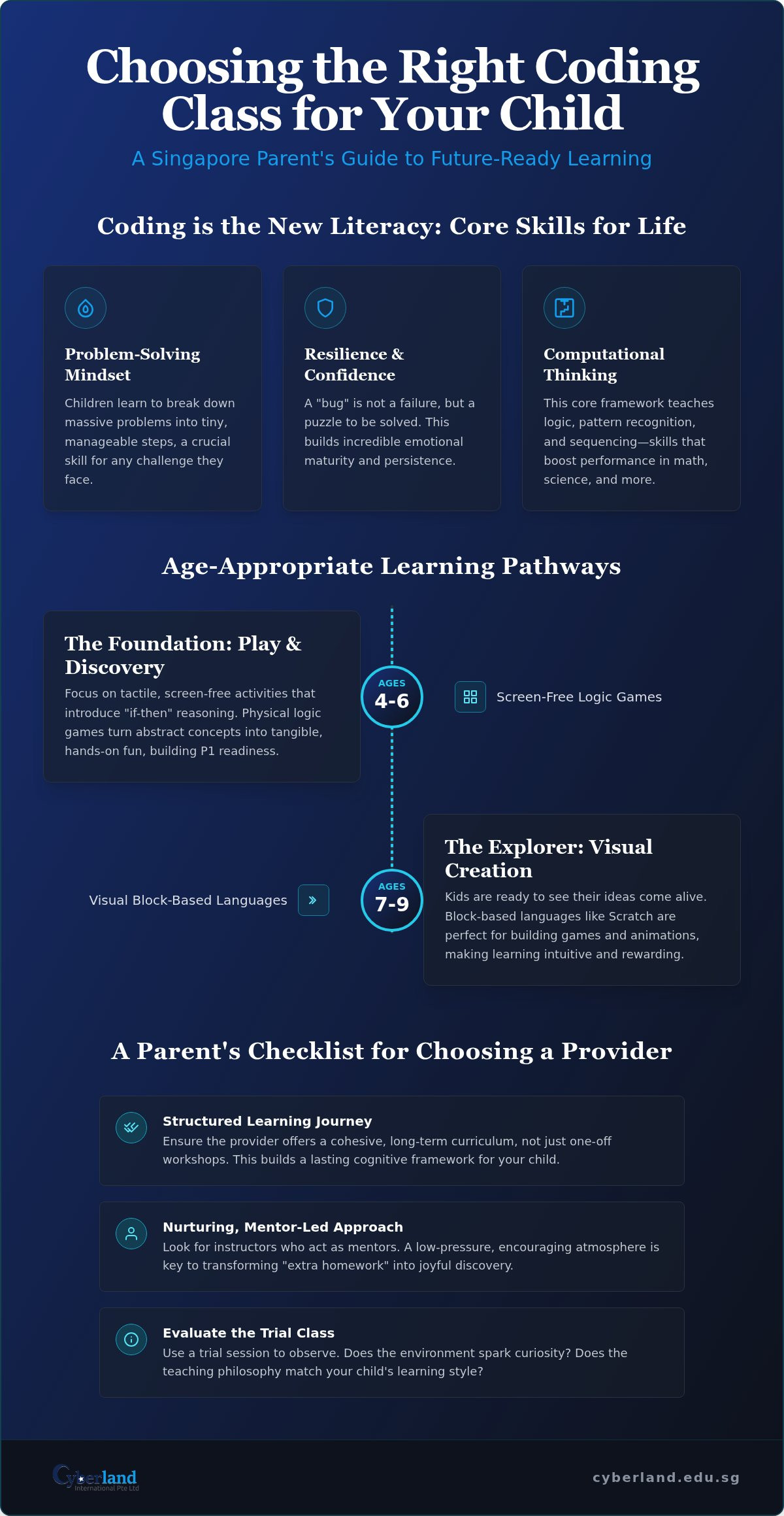
Singapore is a global leader in innovation. By 2026, our Smart Nation vision has moved beyond infrastructure into the very heart of our classrooms. For children aged 4 to 12, coding isn't just about computers. It's about empowerment. It's about moving from being a passive consumer of apps to becoming a bold creator of solutions. When kids learn to code, they develop critical thinking for early learners that stays with them for life. They learn that a "bug" isn't a failure. It's a puzzle waiting to be solved. This mindset builds incredible resilience and emotional maturity at a young age.
Early exposure to technology should feel like play, not pressure. In a nurturing environment, children explore logic through hands-on discovery. They learn to break big, scary problems into tiny, doable steps. This is the core of computational thinking. It's a cognitive framework that helps them excel in math, science, and even language arts. By starting early, we give them the tools to navigate a world where AI and automation are part of daily life. We aren't just teaching them to type; we're teaching them to think.
Coding as the New Literacy
In 2026, digital fluency is as vital as reading and writing. Standard education now requires more than just basic computer skills. It demands creativity. Within the field of educational technology, experts agree that coding is the ultimate tool for creative problem solving. It allows a child's imagination to take physical form in a digital space. Computational thinking is a life skill that enables children to analyze data, recognize patterns, and create logical sequences. It’s the language of the future, and it's being spoken right now.
The Singapore Context: MOE and Beyond
The Ministry of Education continues to expand tech initiatives like the "Code for Fun" and "AI for Fun" programs. These school-based efforts are fantastic, but they often move quickly. Supplemental STEM enrichment programs Singapore families choose can provide the personalized attention a child needs to truly thrive. Knowing how to choose coding class for kids Singapore parents can trust starts with finding a provider that aligns with these national standards while maintaining a low-pressure, encouraging atmosphere. A local hub of innovation, like those found in Ang Mo Kio, offers the perfect bridge between school curriculum and real-world application. It's about finding that sweet spot where learning feels like an adventure.
Finding the Right Fit: Matching Coding Classes to Your Child’s Age
Every child follows a unique developmental path. A four-year-old’s curious mind processes logic differently than a ten-year-old’s analytical brain. When you're researching how to choose coding class for kids Singapore providers, the first step is ensuring the curriculum matches your child's age and cognitive stage. A class that's too advanced can lead to frustration, while one that's too simple might stifle their natural enthusiasm. It’s about finding that "Goldilocks" zone of learning—just challenging enough to inspire growth, but supportive enough to build confidence.
Nursery and Kindergarten Enrichment
For our youngest innovators aged 4 to 6, coding doesn't start with a keyboard. It starts with play. At this stage, we focus on tactile learning and physical logic games that introduce "if-then" reasoning without the need for complex typing. This screen-free foundation is essential. It turns abstract concepts into tangible, hands-on fun. This specialized preschool enrichment Ang Mo Kio parents trust helps build essential P1 readiness by strengthening focus and sequential thinking. By aligning with Singapore's national coding initiatives, we ensure your child’s very first steps into technology are grounded in joyful discovery and professional educational standards.
Primary School Progression
As children move into Lower Primary (Ages 7-9), they’re ready to see their ideas come to life. This is the perfect time for visual block-based languages like Scratch. It’s intuitive. It’s colorful. It allows them to build games and animations instantly. Our Junior Programmer course Singapore framework is specifically built to bridge this gap, moving from simple logic to creative project design. They learn that they aren't just users of technology—they’re the architects behind it.
By Upper Primary (Ages 10-12), the focus shifts toward text-based languages like Python and hardware integration. This is where the magic of "tangible tech" really happens. Integrating coding with robotics workshops for primary schools Singapore students love allows them to see how their code moves physical objects in the real world. This progression ensures they stay engaged as their skills grow. If you're wondering how to choose coding class for kids Singapore programs for this older group, look for modules like Junior Engineer that offer hands-on, interactive challenges.
Logic first. Syntax later. Joy throughout. Our Junior Programmer and Junior Engineer modules are designed to respect these milestones, ensuring every lesson feels like an adventure. If you're ready to see your child's curiosity turn into a lifelong skill, the mentors at Cyberland are here to help you find the perfect starting point.
Assessing Quality: What to Look for in a Coding Provider
Marketing can be loud. When you're researching how to choose coding class for kids Singapore schools offer, it's easy to get lost in flashy promises. The real value lies beneath the surface. You need to look for a curriculum that offers a structured learning journey rather than just a one-off workshop. A "one-and-done" camp might be fun, but a modular approach ensures skills build upon each other. This progression is what leads to the long-term cognitive benefits of coding for children, including improved planning and executive function.
Instructor philosophy is equally vital. Are they merely coders who talk, or are they teachers who code? A great mentor understands child psychology and developmental milestones. They know how to handle a child's frustration when a line of code doesn't work. They turn mistakes into "learning moments." Look for providers that prioritize small class ratios. In a small group, every child gets the attention they deserve. It ensures that no one is left behind and every "aha!" moment is celebrated. Young innovators thrive when they feel seen and supported.
Active creation must always beat passive watching. If a class involves a teacher lecturing while students follow a script, it isn't coding. It's copy-pasting. A quality provider encourages kids to experiment and break things. They should be building, testing, and refining their own projects from day one. This hands-on approach is the secret to deep engagement. It transforms the screen from a distraction into a canvas for innovation.
The "Joy of Discovery" Metric
A nurturing environment is non-negotiable. You can feel the energy when you walk into a room. Is it high-pressure and clinical, or is it warm and inviting? Signs of a great school include a playful atmosphere where curiosity is the primary driver. When a child feels safe to explore, their technical retention skyrockets. They aren't just memorizing syntax; they're falling in love with the process of discovery. This emotional growth is just as important as the code they write.
Technical Infrastructure and Safety
Evaluate the learning environment carefully. Whether it's a physical hub in Ang Mo Kio or a digital space, it must be age-appropriate. This means using hardware and software designed for small hands and young minds. Safety also means a supportive community. A good school fosters a sense of belonging among students. It’s about building a space where every child feels like a bold innovator. When you understand how to choose coding class for kids Singapore providers, you're looking for a partner in your child's growth, not just a service provider.
Maximising the Trial Class: A Parent’s Checklist
The trial class is the ultimate test. It's where you see the theory in action. When you're deciding how to choose coding class for kids Singapore parents can trust, this hour is your best tool. Watch for the "Aha!" moments. These are the seconds where a complex concept suddenly clicks. You'll see it in their eyes. It's the spark of a bold innovator coming to life. A nurturing environment should feel alive with the joy of discovery, not like another hour of quiet desk work.
Look closely at teacher interaction. How does the instructor handle mistakes? In a supportive space, a bug in the code is a puzzle, not a failure. The teacher should act as a reliable guide, helping the child navigate frustration with optimism and patience. By the end of the session, your child should have ignited something uniquely theirs. Whether it's a moving robot or a simple game, that sense of ownership is everything. Watch their face when they leave. Are they drained, or are they beaming with pride? That post-class vibe tells you everything about the school’s emotional trajectory.
Observation Points During the Session
Observe if the teacher encourages creative problem solving. Do they ask "what if we tried this?" or do they just point to the manual? A playful atmosphere allows for real exploration. It's also essential that the curriculum supports individual pacing. Some children want to zoom ahead; others need time to digest the logic. A great class respects both speeds without making anyone feel rushed or bored. You want to see your child engaged, curious, and active throughout the entire session.
Questions to Ask the Provider
Before you commit, have a quick chat with the team. Ask about the long-term junior engineer program for kids pathways to see where the journey leads. You want a school that offers a clear progression, not just a one-off event. Inquire about the specific balance between screen time and hands-on engineering. High-quality programs often integrate physical components to keep kids moving and thinking in three dimensions. Finally, ask how they manage different learning speeds in one class to ensure your child always feels seen and supported.
If they're eager to return, you've found a nurturing partner in their growth. Experience this for yourself by visiting Cyberland today and watching your child's curiosity take flight.
Cyberland’s Junior Programmer: Your Child’s First Step into Innovation
Choosing the right educational partner is a big decision. When you're looking at how to choose coding class for kids Singapore families can rely on, you want a balance of professional expertise and a warm, nurturing touch. Cyberland bridges this gap. We combine deep educational authority with an inviting atmosphere that makes every child feel at home. Our Ang Mo Kio hub serves as a local beacon for innovation, designed specifically to turn "screen time" into "creation time." Here, your child isn't just another student. They're a bold innovator in the making.
The Junior Programmer difference lies in our approach. We don't believe in one-size-fits-all curriculum. Our modules are meticulously crafted for young minds aged 4 to 12. We focus on the cognitive milestones that matter most at each age. Whether it's the tactile logic of our Nursery Enrichment or the complex problem-solving of our Junior Engineer sessions, we ensure the challenge is always matched with encouragement. Ready to see the spark for yourself? You can easily book a kids coding trial class Singapore parents trust to ignite their child’s passion.
Nurturing Curiosity Through Play
Discovery should be fun. Our Junior Programmer and Junior Engineer sessions are built on the belief that play is the highest form of research. Through our STEMtastic modules, we transform abstract concepts into hands-on adventures. We frequently partner with local preschools and primary schools to bring these high-quality experiences directly to the community. This collaborative approach ensures our methods remain at the cutting edge of early childhood tech enrichment. We're more than just a provider; we're a supportive partner in your child's developmental trajectory. Logic. Creativity. Joy. These are the pillars of every session we lead.
Join the Cyberland Community
Becoming part of our family is simple. Our enrollment process is designed to be as stress-free as the classes themselves. Parents often tell us that their children leave our sessions not just with new skills, but with a newfound confidence. They see the positive change in how their little ones approach problems at home and in school. These testimonials from future-ready families drive our passion every single day. We invite you to visit our hub and witness the energy firsthand. Let’s spark your child’s curiosity together. Your journey into innovation starts with a single step, and we’re here to guide you every inch of the way.
Ignite Your Child’s Digital Future
Finding the right path for your little innovator starts with understanding their unique developmental needs. We've explored how a structured curriculum and a nurturing instructor philosophy are the foundations of long-term success. By prioritizing active discovery over passive screen time, you ensure that coding remains a joyful adventure rather than a chore. Knowing how to choose coding class for kids Singapore families can rely on means looking for an environment where curiosity is celebrated and small groups allow for personalized guidance.
As a trusted STEM partner for Singapore preschools, we are committed to redefining enrichment through hands-on discovery. Our nurturing, small-group environment ensures your child feels seen, supported, and inspired to create. Ready to watch their logical thinking skills soar? Book Your Junior Programmer Trial Class Today! Let's build a bright, future-ready foundation together. The world of innovation is waiting for them to take their first bold step.
Frequently Asked Questions
What is the best age for a child to start coding in Singapore?
The best age to start is between 4 and 6 years old. At this stage, children are like sponges, absorbing logic through play-based discovery. Our Nursery Enrichment and Kindergarten Enrichment programs focus on foundational thinking rather than complex syntax. By starting early, your child develops a cognitive framework that makes future learning much easier. It's about igniting curiosity in a supportive environment where every small victory is celebrated by our mentors.
Does my child need a laptop for a kids coding trial class in Singapore?
No, your child typically doesn't need to bring a laptop for a trial session. We provide all the necessary technical infrastructure and age-appropriate hardware at our Ang Mo Kio hub. This allows your child to dive straight into the fun of hands-on creation without technical hurdles. When considering how to choose coding class for kids Singapore providers, check if they provide a complete, safe, and ready-to-use learning environment for every student.
Is coding too difficult for a 4-year-old in nursery?
Not at all. Coding for a 4-year-old isn't about typing lines of text on a screen. It's about sequential thinking and "if-then" logic explored through physical games and tactile puzzles. Our specialized modules make these abstract concepts tangible and fun. We focus on building resilience and problem-solving skills in a low-pressure setting. This ensures that your child feels like a bold innovator while they're simply having the time of their lives.
How much do coding classes for kids usually cost in Singapore?
Fees for enrichment programs in Singapore vary based on the curriculum depth, class ratio, and session duration. Most providers offer structured modules or holiday workshops; it's best to inquire directly for the most accurate details. When you're researching how to choose coding class for kids Singapore options, prioritize the quality of the instructor and the small-group environment. Investing in a nurturing space ensures your child receives the personalized attention they need to thrive.
What is the difference between Scratch and Python for young learners?
Scratch is a visual, block-based language perfect for children aged 7 to 9. It uses colorful "bricks" to build games, making it highly intuitive. Python is a text-based language suited for older children, typically aged 10 and above. It introduces them to professional syntax used in the real world. Both are vital steps in a child's journey. We use these tools to bridge the gap between creative imagination and technical execution as they grow.
Can coding help my child with Primary One preparation?
Yes, early tech literacy builds essential skills for the Primary One transition. Coding strengthens a child's ability to focus, follow multi-step instructions, and think sequentially. These are the same logical foundations required for P1 mathematics and English. Our enrichment programs are designed to complement the national curriculum, giving your child a head start in confidence. It's a wonderful way to ensure they enter the primary school environment feeling empowered and ready for new challenges.
What happens during a typical Cyberland Junior Programmer session?
Every Junior Programmer session is a blend of professional guidance and joyful discovery. We start with a high-level goal, move into a specific developmental focus, and finish with a hands-on project. Children work in small groups, allowing our mentors to provide individual support. The atmosphere is energetic and organized, ensuring every child stays moving through the information without feeling overwhelmed. It’s an interactive experience where your child's ideas truly come to life through technology.
How do I know if my child has a "talent" for coding?
"Talent" in coding often looks like simple curiosity. If your child enjoys puzzles, building blocks, or asking "how does this work?", they have the perfect foundation. We believe every child can excel when given the right tools and a supportive guide. Look for a sense of wonder and engagement during their first few sessions. Our goal is to nurture that interest until it becomes a lifelong skill, regardless of their initial technical ability.


Comments