
9 Problem Solving Activities for Singapore Preschoolers

Updated: Aug 8
What if your child’s next "messy" play session was actually a masterclass in engineering? Every parent in Singapore feels that P1 pressure. It's tough seeing your little one glued to a tablet when you know our local school landscape demands sharp, critical thinking. Finding problem solving activities for preschoolers Singapore families can enjoy together shouldn't be a struggle. You want to see your child tackle challenges with confidence, not just follow instructions.
We understand the worry of explaining complex logic to a toddler. It's about more than just "getting it right"; it's about the joy of discovery. This article promises to show you how to ignite your child's natural curiosity through playful, future-ready tasks. We've curated nine actionable ideas that build independence and prepare them for the latest curriculum standards. Get ready to explore hands-on games and creative challenges that transform screen time into brain time, setting the stage for a smooth transition to primary school.
Table of Contents
Why Problem Solving Activities for Preschoolers Matter in Singapore
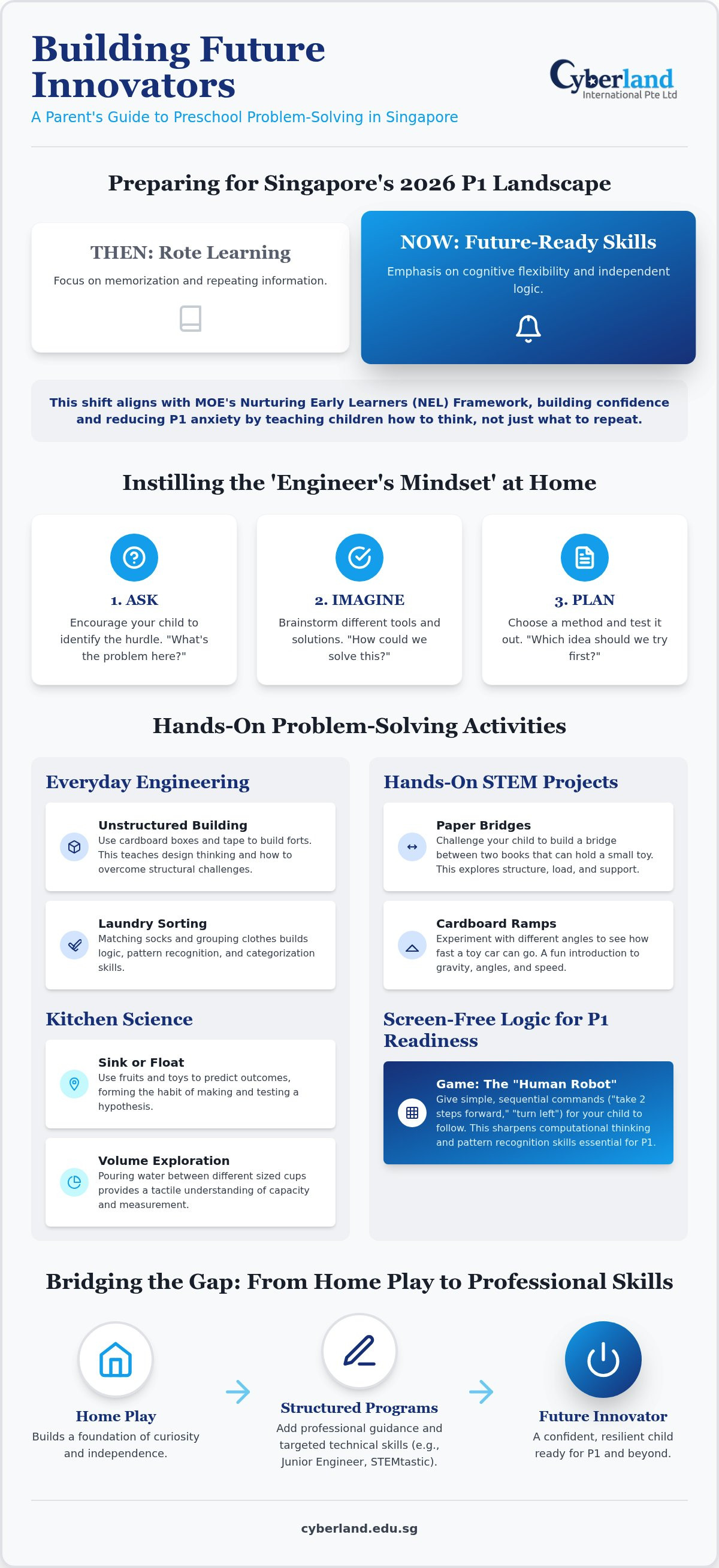
Problem-solving is the quiet superpower of early childhood. It's the ability to spot a hurdle, look at it from different angles, and find a way through independently. In 2026, Singaporean parents are prioritizing cognitive flexibility over the old-school focus on rote learning. This shift is a response to a global economy that values adaptable thinkers. By introducing problem solving activities for preschoolers Singapore families can help their children build a foundation that lasts a lifetime. It’s about teaching them to think, not just to repeat.
These foundational problem-solving skills are directly linked to the MOE Primary 1 curriculum. The updated Nurturing Early Learners (NEL) Framework emphasizes learning dispositions like perseverance and reflectiveness. When a child learns to reason through a small challenge at age four, they're preparing for the academic rigour of age seven. Success in small tasks builds massive confidence. It reduces the "P1 anxiety" that many kids feel during the transition. A child who knows they can fix a broken toy bridge is a child who won't panic when they encounter a tricky math word problem later on. They see a challenge and think, "I can handle this."
The 'Engineer's Mindset' in Early Childhood
We want our little ones to move beyond looking for a single "right" answer. The goal is to spark curiosity about the "how" and "why." When a block tower crashes, it's not a failure. It's a data point. Encouraging this persistence helps children identify potential problems before they even happen. They start to see the world as a series of puzzles waiting to be solved. This mindset turns every setback into a stepping stone for growth. It builds the grit necessary for future success in subjects like science and mathematics.
Singapore’s Focus on 21st Century Competencies
Critical thinking is a pillar of Singapore’s holistic development framework. Local preschools are shifting from academic drills toward creative inquiry. This prepares kids for a future where tech-literacy is the baseline requirement for almost every career. By engaging in problem solving activities for preschoolers Singapore children develop the mental agility needed for the modern world. They learn to question, explore, and innovate. These are the competencies that transform a student into a future leader. It's not just about school; it's about life.
Developing these traits can also happen on the sports field, where precision and patience are key. For families looking to supplement their child's growth with specialized training, SgGolfCoach offers professional coaching that helps build the focus and strategic thinking necessary for success in any field.
Everyday Home Activities to Spark Interest in Engineering
Engineering isn't reserved for laboratories. It lives in your kitchen, your living room, and even your laundry basket. You don't need expensive gadgets to spark a child's curiosity. You just need a shift in perspective. Transforming daily chores into "Mission Possible" challenges is a brilliant way to introduce problem solving activities for preschoolers Singapore parents can start today. It turns a mundane task into a high-stakes adventure. When a child sees a messy room as a spatial puzzle to be solved, their brain switches into high gear.
Use the "Ask, Imagine, Plan" framework for your 4-year-old. If a ball rolls under the sideboard, don't just grab it for them. Ask: "What's the problem?" Imagine different tools like a ruler, a stick, or an umbrella. Plan which one to use first. This simple ritual builds the mental pathways for formal logic. It's the same logic used in our Junior Engineer program for kids, where play meets professional guidance. By practicing this at home, you're teaching them that every problem has a manageable solution.
Unstructured building is your child's best precursor to formal engineering. Give them cardboard boxes, masking tape, and recycled containers. Let them build a "fort" or a "rocket." The benefits of play for children's development are immense, especially when they hit a snag and have to rethink their design. These moments of "productive struggle" are where the real learning happens. They learn that failure is just another step in the design process.
Kitchen Science and Measurement
Baking: Measuring ingredients is a lesson in precision and sequences. Watching bread rise is pure chemistry in action.
Sink or Float: Use fruit like apples or grapes. Predict the outcome first. It builds the habit of forming hypotheses.
Volume Exploration: How many small yogurt cups fill the big water jug? It’s a tactile way to understand capacity and volume.
Sorting and Categorizing for Logic
Laundry Sorting: Matching socks and grouping shirts by color develops sharp pattern recognition.
Toy Hospital: Diagnosing why a pull-back car is stuck builds troubleshooting skills and empathy.
Organizing Books: Sorting by height, color, or genre introduces the foundational concepts of data organization.
Hands-on STEM Activities for Future Junior Engineers
Moving beyond simple sorting helps children develop a deeper understanding of the physical world. While earlier sections focused on everyday chores, these problem solving activities for preschoolers Singapore parents can facilitate at home dive into the mechanics of how things actually work. It’s time to think like a builder. We want kids to experiment with structural stability and mechanical logic through high-energy, tactile play. This approach mirrors our Junior Engineer philosophy: we value the process of testing, failing, and redesigning over a perfect first attempt.
Start with a classic block tower challenge. Ask your child to build the tallest structure possible using only ten blocks. They'll quickly discover that a wide base provides more support than a narrow one. If the tower topples, don't rush to fix it. Ask them why it fell. Was it too top-heavy? Did the floor shake? This iterative cycle of observation and adjustment is the heart of engineering. It teaches children that "failure" is just a necessary step toward a stronger design.
The Paper Bridge Challenge
This activity introduces the concept of structural integrity. In child-friendly terms; structural integrity means how strong and steady something is so it doesn't break or fall down. Follow these steps to get started:
Step 1: Create two "cliffs" by placing two stacks of books of equal height about 15cm apart.
Step 2: Provide your child with different types of paper, such as tissue paper, construction paper, and cardstock. Ask them to lay a single sheet across the cliffs.
Step 3: Test the bridge's strength by placing 20-cent coins on it one by one. Encourage them to fold the paper into "fans" or "tunnels" to see how changing the shape impacts how much weight it can hold.
Ramps and Friction Exploration
Simple machines like inclined planes are perfect for exploring physics. You can create a "car race" track using long pieces of cardboard or empty mailing tubes. To make it a true problem-solving task, introduce different surface textures. Compare how fast a toy car moves on a ramp covered in bubble wrap versus one made of smooth wood.
Ask your child to adjust the height of the ramp by propping it up with more books. Does a steeper ramp make the car go further? What happens if the surface is "sticky" like a towel? These observations help children grasp the basics of friction and gravity. By experimenting with these variables, they aren't just playing; they're conducting their first scientific trials. This hands-on engagement is exactly what prepares them for the creative inquiry expected in Primary 1.
Developing Logical Thinking for Preschoolers: P1 Readiness
Logical thinking is the bridge between creative play and academic success. In Singapore, the jump to Primary 1 often requires children to follow multi-step instructions and recognize complex sequences. While building blocks are great for physical logic, computational thinking helps children organize their thoughts. You don't need a computer to teach this. In fact, many problem solving activities for preschoolers Singapore parents love are completely screen-free. These activities focus on the "why" behind a sequence, helping kids understand that their actions have predictable results. It builds the mental stamina needed for the 2026 curriculum standards.
Pattern recognition is another vital pillar of logic. You can find patterns everywhere, from the tiles in a void deck to the rhythm of a favorite song. Encourage your child to identify what comes next. This habit sharpens their focus and prepares them for mathematical sequences. We also use "First-Then" logic in daily routines. "First we pack our bag, then we put on our shoes." This simple phrasing builds the foundation for algorithmic thinking. It helps kids understand that one action leads to another. When combined with roleplaying social scenarios, like "What would you do if a friend took your toy?", you're nurturing a child who can navigate both the social and academic hurdles of a Singapore school.
Unplugged Coding Games
The "Human Robot" game is a household favorite. Ask your child to "program" you to walk from the sofa to the kitchen. They must give specific commands like "take three steps forward" or "turn right." If they forget a step and you walk into a wall, that's a bug! They have to go back and fix the code. This teaches them about debugging and precision. You can even introduce loops by asking them to repeat a dance move three times. It’s a fun, active way to learn the basics of programming before they even touch a keyboard.
Strategic Board Games for Kids
Strategic board games are powerful tools for enhancing focus. Simple classics like Tic-Tac-Toe or Memory Match aren't just for passing time. They build predictive thinking. Your child has to imagine what your next move might be and plan accordingly. Cooperative games are especially useful for social problem solving. They encourage kids to work together to reach a goal, which is a vital skill for collaborative school projects. If you want to see your child apply these skills in a professional, high-energy setting, explore our Junior Engineer and Kindergarten Enrichment workshops.
Nurturing Young Innovators with Cyberland's STEM Programs
Home play is a wonderful starting point for any child. But to truly accelerate development, a structured environment makes a massive difference. Cyberland bridges the gap between casual discovery and professional technical skills. We provide expert-led problem solving activities for preschoolers Singapore parents can rely on for measurable growth. Our workshops take the "Ask, Imagine, Plan" framework and apply it to real-world scenarios. We provide the tools, the space, and the mentorship that allow a child's curiosity to flourish. It’s about moving from simple play to intentional innovation.
The STEMtastic workshop experience is designed for high engagement and sensory learning. With the 2026 curriculum updates for STEMtastic, we ensure every session is future-ready and aligned with current educational standards. We partner with local preschools and primary schools across the island to bring these innovative methods directly to the classroom. By creating a collaborative space, we help kids learn from one another while tackling complex hurdles. This community-driven approach turns individual effort into shared success, building the social logic needed for the P1 transition.
Junior Programmer: Logic in Action
Moving from "unplugged" logic to basic block-based coding is a major milestone for any little learner. In our Junior Programmer sessions, children see their logical sequences come to life. They develop the patience to troubleshoot technical challenges, learning that a "bug" is just a puzzle waiting for a solution. Located in Ang Mo Kio Industrial Park 2, our center is a dedicated hub for "learning by doing." We don't just teach code; we ignite the persistence required to navigate the digital world with confidence.
Junior Engineer: Building the Future
Our Junior Engineer program for kids is specifically crafted to spark a lifelong interest in engineering. These modules dive into mechanics and physics through hands-on projects that little hands can actually master. From understanding gear ratios to exploring structural stability, we make complex physical principles accessible and fun. It’s an invitation to join the next generation of Singaporean innovators. Let's build a brighter, smarter future together at Cyberland. Your child’s journey toward becoming a confident problem solver starts here.
Empower Your Little Innovator for a Brighter Future
Your child’s journey toward critical thinking starts with a single "why." From kitchen science to building paper bridges; the problem solving activities for preschoolers Singapore families use at home lay a vital foundation. You’ve seen how simple chores and unplugged logic games transform into powerful lessons in engineering. These small wins build the massive confidence your child needs for a successful P1 transition. It's about turning curiosity into a lifelong skill.
While home play is essential, a structured environment can accelerate this growth. Cyberland is a trusted partner of Singapore schools. We offer expert-led workshops for ages 4-12 that spark real transformation. Our hands-on STEMtastic curriculum turns complex concepts into moments of pure wonder. We help children move beyond rote learning to become bold, independent thinkers who aren't afraid of a challenge. The future belongs to the curious.
Ignite your child's curiosity; Explore Cyberland's Junior Engineer Programs today!
Let's nurture that spark of genius together. Your child is ready to build something amazing.
Frequently Asked Questions
What are age-appropriate problem-solving activities for a 4-year-old?
Four-year-olds thrive on sensory-rich tasks like scavenger hunts or simple "if-then" storytelling games. You can ask them to find objects that are "blue and soft" to build sharp categorizing skills. Building with large wooden blocks or sorting grocery items by color are also excellent ways to start. These tasks focus on observation and basic logic without requiring complex motor skills. It's about making the challenge feel like a fun game.
How can I encourage my child to solve problems without getting frustrated?
Focus on praising your child’s effort rather than just the final result to keep frustration at bay. If they hit a snag, ask open-ended questions like "What else could we try?" instead of giving the answer. This approach turns a "mistake" into a valuable learning opportunity. It’s about building the resilience to keep trying until the puzzle pieces finally fit together. Celebrate the "productive struggle" as much as the success.
If persistent frustration becomes a barrier, it can be helpful to look at the root causes. Specialized development centers like Firststep Psychology & Child Development Centre offer comprehensive assessments that help parents identify any underlying challenges and provide the right support for their child's growth.
Are STEM activities too difficult for preschoolers?
STEM activities are perfectly suitable for preschoolers when they're delivered through hands-on, playful exploration. It’s not about complex formulas; it’s about understanding how things work in the real world. Simple tasks like exploring ramps or building paper bridges make high-level concepts accessible. These activities spark a sense of wonder and curiosity. They make learning feel like a grand adventure rather than a difficult school chore.
How do problem-solving skills help with Primary 1 preparation in Singapore?
Problem-solving skills are a cornerstone of P1 readiness because they align with the Ministry of Education’s Nurturing Early Learners framework. These skills help children handle the academic and social hurdles of primary school with confidence. By practicing problem solving activities for preschoolers Singapore parents ensure their kids can follow multi-step instructions independently. This mental agility is vital for a smooth transition into a more structured school environment.
Can coding activities be done without a computer for young kids?
Yes, coding for young kids is often more effective when done without a screen through active games. You can use physical movements to teach concepts like "loops" or "sequences" by repeating specific dance steps. Pattern recognition in music or nature also builds the foundational logic needed for programming later on. It’s about teaching the brain how to organize information. We focus on these "unplugged" basics before introducing a digital interface.
What is the 'Engineer's Mindset' and why is it important for preschoolers?
The 'Engineer's Mindset' is a way of thinking that focuses on curiosity, persistence, and proactive troubleshooting. It encourages children to ask "how" and "why" things happen rather than just looking for a single right answer. This mindset is important because it teaches kids that failure is just a data point for a better design. It builds the grit needed to solve complex problems. It prepares them for a lifetime of innovation.
Where can I find STEM workshops for preschoolers in Singapore?
You can find high-energy, expert-led workshops at Cyberland, located in Ang Mo Kio Industrial Park 2. We offer specialized modules like Junior Engineer and STEMtastic that are tailored for children aged 4 to 12. Our programs provide a structured environment where kids can apply their thinking skills to real-world projects. It’s a great way to bridge the gap between home play and professional enrichment. We help your child reach their full potential.
How often should my child practice these thinking activities?
Consistency is better than intensity, so try to integrate problem solving activities for preschoolers Singapore into your daily routine in short, 10-minute bursts. You don't need a formal lesson plan every day. Simply asking a "how" question during bath time or a "what if" question during a walk counts as practice. The goal is to make critical thinking a natural part of your child's life. Short, frequent sessions keep the spark of interest alive.


Comments