
Coding Classes for Preschoolers Singapore: 5 Creative Examples of Early Learning
- Daniel Chua
- Aug 9
- 12 min read

Updated: Aug 10
What if the best way to prepare your child for the rigors of Primary One isn't through a textbook, but through play? Many parents feel the weight of early academic pressure in Singapore. You might worry about adding more to your child's plate or fear that coding classes for preschoolers Singapore just mean more screen time. It's a valid concern. However, the most effective programs today focus on building logical architecture rather than just staring at a monitor. The goal is to ignite a passion for discovery that lasts a lifetime.
We understand you want to spark curiosity without the burnout. You're looking for a bridge between simple games and actual cognitive growth. In this article, you'll discover how these classes use tactile, hands-on activities to sharpen problem-solving skills and build a resilient mindset. We'll explore five creative examples of early learning that transform abstract concepts into tangible fun. From screen-free robots to sequencing adventures, these methods ensure your little one is ready for the future while still enjoying the magic of their childhood.
Table of Contents
Why Start Early? The Benefits of Coding Classes for Preschoolers in Singapore
The ages of 4 to 6 represent a magical "Critical Period" for cognitive development. During these years, a child's brain is exceptionally plastic and receptive to new logic structures. Enrolling your child in coding classes for preschoolers Singapore isn't about teaching them to type complex syntax on a dark screen. It's about nurturing their natural curiosity. We want to move them from being passive consumers of technology to becoming active creators. It's a shift from watching a screen to understanding the "why" behind the movement.
Developing Computational Thinking in Early Learners
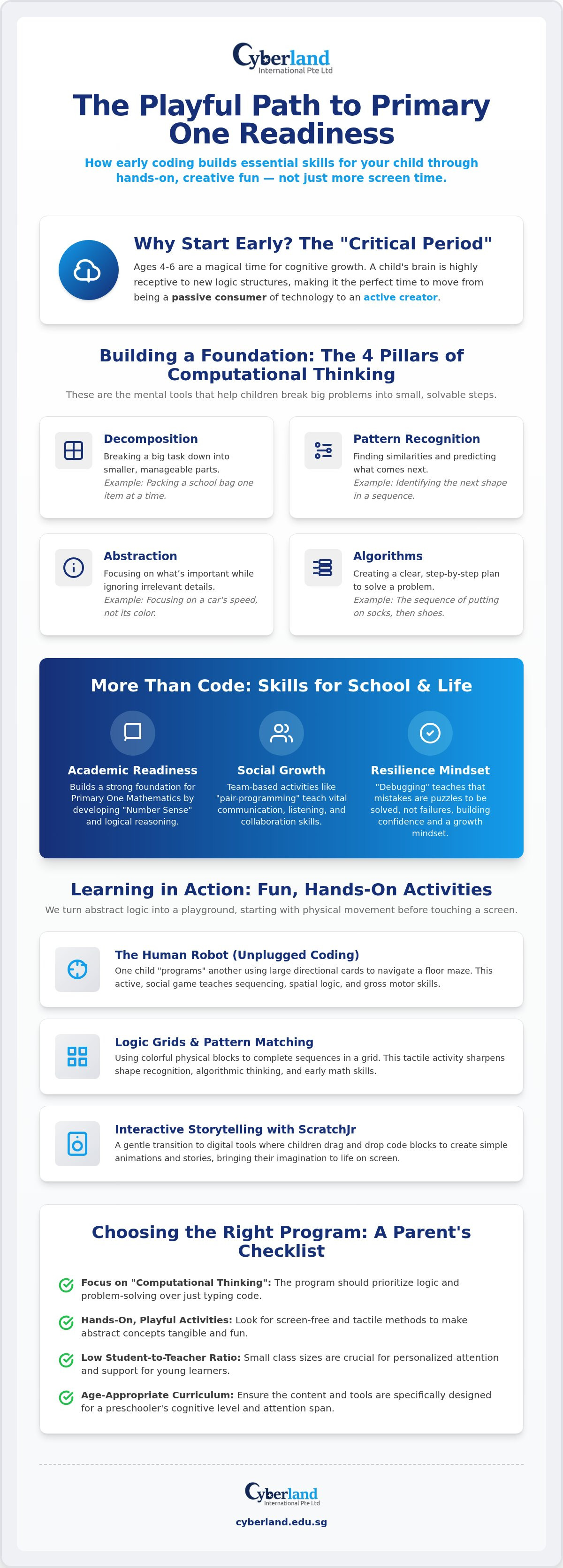
At this developmental stage, coding is synonymous with What is computational thinking. This foundational skill is the ability to break big problems into small, solvable steps. It's a mental toolkit that helps children navigate the world around them. There are four main pillars that we focus on during our enrichment sessions:
Decomposition: Breaking a task down. Think of it like packing a school bag; you need the water bottle, then the snack box, then the books.
Pattern Recognition: Finding similarities. Does this puzzle piece look like the last one that fit?
Abstraction: Focusing on what matters. We learn to ignore the color of a car to focus on how fast it moves.
Algorithms: Creating a step-by-step plan. First, we put on socks. Then, we put on shoes.
In the Singapore context, these skills are vital. They build a strong foundation for "Number Sense" and logic, which are core components of the Primary One Mathematics syllabus. By starting early, children develop the mental architecture needed for academic success without the stress of rote memorization. They learn to see math as a series of patterns and logical steps rather than just numbers on a page.
Social and Emotional Growth through Collaborative Coding
Coding is rarely a solo activity in our workshops. We use a team-based approach where children engage in "pair-programming." This builds essential communication skills. They learn to share ideas, listen to peers, and solve problems together. It's a vibrant, social environment that mirrors real-world innovation. We move away from the "lone coder" myth and embrace a collaborative, workshop-style atmosphere.
One of the most powerful lessons is "debugging." When a sequence doesn't work, we don't call it a failure; we call it a puzzle. This mindset shifts how children view mistakes. It teaches resilience and a growth mindset. Instead of giving up, they learn to ask, "Why did that happen?" and "How can I fix it?" This emotional maturity is just as important as the technical logic they gain. It prepares them to face challenges in Primary One with confidence and a smile.
5 Engaging Examples of Preschool Coding Activities in 2026
Forget the image of a child hunched over a keyboard. In our coding classes for preschoolers Singapore, we believe in a vibrant, hands-on philosophy. We call this the "Junior Programmer" approach. It's about turning abstract logic into a playground. We start with physical movement and slowly transition to digital tools. This ensures children understand the "how" before they ever touch a screen. The best part? Seeing that "Aha!" moment when their plan actually works.
Example 1: The Human Robot (Unplugged Coding)
This is a favorite in our workshops. One child acts as the "Programmer" while another becomes the "Robot." The programmer uses large directional cards like "Up," "Down," "Left," and "Right" to guide the robot through a floor maze. It's loud, active, and incredibly fun. By physically directing a friend, children learn about sequencing and spatial logic. They aren't just thinking; they are moving. This builds gross motor skills alongside their developing "Number Sense."
Example 2: Logic Grids and Pattern Matching
We use colorful physical blocks to explore algorithmic thinking. A child might encounter a grid with a missing piece in a sequence. Identifying "what comes next" is the very foundation of coding logic. This activity sharpens shape recognition and early mathematics skills. It's a tactile way to show that problems have predictable solutions. If you want to see how these foundations are built, you can explore our Junior Programmer modules for more details. It's a gentle way to ignite interest without academic pressure.
Example 3: Interactive Storytelling with ScratchJr
Transitioning to digital tools feels natural when it's icon-based. Using ScratchJr, preschoolers create their own animations without needing to read complex text. Forbes highlights how a Five Year Old Can Learn To Code by simply dragging blocks. We introduce the concept of "loops" here. A child might drag a repeat block to make a kitten character dance forever. It's creative expression powered by pure logic.
Example 4: Junior Engineer Stability Challenges
Coding isn't just about software; it's about systems. In these challenges, children use building kits to create structures. They might build a tower and then "debug" it when it leans too far. This introduces structural logic and stability. It shows that the same step-by-step thinking used in code applies to the physical world around them. It's about building a mind that understands how things fit together.
Example 5: Narrative Sequencing Cards
We use story cards to teach the importance of order. A child might have three cards: "Planting a seed," "Watering the dirt," and "A flower blooming." If the order is wrong, the "program" fails. This simple exercise reinforces that the sequence of events is critical. It's a screen-free way to master the logic of algorithms before moving to more complex tasks. Each card placement is a small victory in logical thinking.
Beyond the Screen: How Coding Prepares Kids for Primary One
Transitioning to Primary One is a big milestone in Singapore. Many parents worry about the leap in academic expectations. High-quality coding classes for preschoolers Singapore act as a bridge. They don't just teach tech; they build the cognitive stamina required for a formal classroom, much like the readiness programs offered at Jumpstart Learning Academy. By focusing on logical sequences, children develop the mental discipline needed to sit through 30-minute focused tasks. It's about preparing the mind, not just the hands. We want every child to walk into their new school feeling capable and curious.
Bridging the Gap to P1 Mathematics and Logic
The Singapore Mathematics syllabus emphasizes a step-by-step approach to problem-solving. Coding mirrors this perfectly. When a child creates a sequence, they're practicing the same logic used to solve a math word problem. They learn to identify the start, the middle, and the end. This prevents them from feeling overwhelmed by complex questions later on. It builds confidence. It builds grit. They start to see that every big problem is just a collection of smaller, manageable parts.
Debugging is another critical skill. In school, we often call it "checking your work." In our workshops, children learn that the first try isn't always the final one. They hunt for the "bug" and fix it. This removes the fear of making mistakes. Instead of erasing an answer in frustration, they view it as a puzzle to be solved. This mindset is invaluable for the rigorous P1 exams. It turns a potential stressor into a moment of triumph. It's about resilience in action.
The 'Unplugged' Advantage: Coding without Computers
We take screen time concerns seriously. For the 4-5 year old age group, Cyberland prioritizes "unplugged" curriculum hours. We use physical manipulatives and tactile tools. This "tactile coding" is essential for sensory development. It allows children to touch, move, and feel the logic they're creating. We balance digital literacy with traditional play-based learning to ensure a healthy developmental trajectory. It's about the joy of discovery, not just staring at a monitor.
Our approach integrates structure and stability through our Junior Engineer concepts. While coding focuses on the "brain" of a system, engineering focuses on the "body." Understanding how a structure stands helps children visualize the physical impact of their logical choices. For a broader look at how we integrate these fields, check out our Junior Engineer Programs for Kids: 2026 Guide. It's a holistic way to spark curiosity in STEM. We believe in building a foundation that's both strong and flexible. This ensures your child is ready for Primary One and beyond.
Choosing the Best Coding Enrichment in Singapore: A Checklist
Finding the right fit for your child is a journey of discovery. It's not just about the curriculum; it's about the connection. When you search for coding classes for preschoolers Singapore, start with the numbers. A low student-to-teacher ratio is non-negotiable. For children aged 4 to 6, a ratio of 1:6 or 1:8 ensures every little learner receives the attention they need to blossom. High-quality instruction requires a watchful eye and a nurturing hand. It's about safety, focus, and personalized guidance.
Ask about the progression. Does the school offer a clear path forward? You want a partner in your child's development, not just a one-off service. Look for specific modules like our Junior Programmer series that grow with your child. This ensures the learning continues as their skills evolve. Also, consider the environment. Is the space inspiring? Our center in Ang Mo Kio Industrial Park 2 is designed to be a fun, non-academic sanctuary where curiosity leads the way. It's a place where big ideas start small.
Curriculum vs. Play: Finding the Right Balance
Preschoolers don't learn by sitting still for long hours. A rigid classroom style often leads to frustration. Instead, look for programs that integrate STEMtastic workshops. These sessions combine science, technology, and engineering into one cohesive, playful experience. It's about "doing" rather than "rote memorization." You can tell a program is teaching genuine logic if the children can explain why their project works, rather than just what buttons they pressed. Play is the work of childhood. Coding should feel like the best kind of play.
Evaluating Instructor Expertise in Early Childhood
Technical skill is only half the battle. Instructors must understand child psychology and developmental milestones. They should be mentors who know when to step in and when to let a child struggle productively. During a trial class, watch how they engage with the students. Do they get down to the child's eye level? Do they use sensory language that sparks wonder? A local Singapore context is also helpful. It ensures the teaching methods align with the communication styles your child is familiar with. Ready to see our mentors in action? Book a trial for our Kindergarten Enrichment today and watch your child's curiosity ignite.
Check the Ratio: Aim for 1:6 or 1:8 for maximum engagement.
Verify Age-Appropriateness: Ensure it's not just a watered-down adult course.
Look for Progression: Ask about follow-up modules like Junior Programmer.
Assess the Space: Visit the center to ensure it's safe and inspiring.
Cyberland’s Junior Programmer: Igniting Curiosity in Ang Mo Kio
Located in the heart of Ang Mo Kio Industrial Park 2, our center is more than just a school. It's a launchpad for young minds. We've designed our coding classes for preschoolers Singapore to be a cohesive journey that sparks wonder at every turn. We don't just teach code; we build future-ready thinkers. By pairing the Junior Programmer and Junior Engineer modules, we provide a 360-degree view of how the modern world works. One day, your child is sequencing a playful dance for a digital kitten. The next, they're building a physical structure that stands tall against a stability test. This integrated approach ensures that the logic they learn is grounded in something they can touch and feel.
For parents seeking a truly holistic experience, our STEMtastic workshops are the perfect addition. These sessions are where science meets technology in a burst of creative energy. They are interactive, sensory-focused, and filled with the joy of discovery. We believe that curiosity is a muscle that needs regular exercise. The more we use it, the stronger it gets. Our workshops encourage children to ask "why" and "how" as they experiment with different tools. It's about creating a safe space where every question is a step toward a new discovery.
A Supportive Environment for Future Innovators
Cyberland is a hands-on environment by design. We don't believe in passive learning or long lectures for four-year-olds. Every child is encouraged to touch, build, and explore with their own hands. Our "nurturing mentor" approach is specifically crafted to help even the shyest children gain confidence. We've seen little ones who were initially hesitant to speak up blossom into bold problem-solvers. This transformation is the heart of our mission. We also partner closely with local Singapore preschools to bring our specialized curriculum directly to classrooms, ensuring high-quality STEM education is accessible and familiar to families across the island.
Cultivating this sense of self-assurance often extends to personal milestones outside the classroom; for parents looking for a safe and professional way to mark these moments, Stellar SG offers a premium ear piercing experience specifically for children in Singapore.
Take the First Step Toward Logical Mastery
The Junior Programmer journey is about more than just Primary One readiness. It's about fostering a lifelong love for technology and engineering. Early exposure removes the mystery and intimidation of the digital world. It empowers children to be masters of their tools rather than just passive users. When a child understands the logic behind the screen, they're no longer just playing; they're innovating. We invite you to see this transformation in person. It's time to ignite that spark of curiosity. Register your child for a Cyberland enrichment program today! and watch them take their first confident step toward logical mastery.
Empower Your Little Innovator Today
Early learning is a journey filled with wonder. We've explored how playful logic and hands-on sequences build the mental architecture your child needs. It's not about memorizing code. It's about developing the grit to solve puzzles and the curiosity to ask "why." These foundational skills ensure a smooth, confident transition into the Singapore Primary One syllabus and beyond. Choosing the right coding classes for preschoolers Singapore is the first step toward a lifelong adventure in STEM.
At Cyberland, we're proud to be your partner in growth. Our specialized Junior Programmer curriculum for ages 4-6 is designed to nurture every child's unique potential. From our hands-on STEMtastic workshops trusted by Singapore schools to our vibrant center in Ang Mo Kio, we provide the perfect environment for discovery. We don't just teach tech; we inspire the next generation of creators. Your child's future is bright, and it starts with a single, curious step.
Frequently Asked Questions
What is the best age to start coding classes for kids in Singapore?
Four years old is the ideal age to begin. This is a "Critical Period" where a child's brain is incredibly receptive to new logic structures. At this stage, coding classes for preschoolers Singapore focus on computational thinking rather than typing. We use play to train their minds to see patterns and sequences before they even reach Primary One.
Will my preschooler spend the whole class looking at a screen?
Not at all. We prioritize a balanced, "unplugged" curriculum for our youngest learners. Most of the time is spent using physical robots, floor mazes, and building blocks. This tactile approach ensures children develop gross motor skills and social communication. Digital tools are only introduced once the physical logic is firmly understood.
Does my child need to know how to read before joining a coding class?
Reading isn't a requirement for our early modules. Our Junior Programmer activities use visual, icon-based interfaces. Children use symbols and images to create their sequences. This allows them to master complex logical concepts through intuition. It's a fantastic way to build confidence in children who are still developing their literacy skills.
How do coding classes help with Primary One preparation?
These sessions build the mental stamina required for the formal classroom. By learning to break down big problems into small steps, children find the P1 Mathematics syllabus much less intimidating. High-quality coding classes for preschoolers Singapore also teach "debugging." This helps kids view mistakes as puzzles to be solved rather than failures.
What is the difference between Junior Programmer and Junior Engineer modules?
Think of them as the "brain" and the "body" of a system. Junior Programmer focuses on software logic, sequencing, and algorithmic thinking. Junior Engineer explores physical structures, stability, and how things are built. When combined, they provide a holistic STEM experience that helps children understand how the entire world fits together.
Are there trial classes available for preschoolers at Cyberland?
We invite parents to inquire about trial sessions to see our philosophy in action. It's a wonderful opportunity to observe how your child interacts with our mentors and hands-on tools. Seeing that first "Aha!" moment is often what convinces parents of the value of early STEM exposure. Every innovator starts with a single session.
How long are the coding sessions for 4 to 6-year-olds?
Sessions are carefully structured to respect a preschooler's natural attention span. We alternate between high-energy physical activities and focused logical tasks. This rhythm mirrors the 30-minute work blocks they'll encounter in Primary One. It's about building their concentration muscles gradually while keeping the environment fun and non-academic.
Where is Cyberland located and is it accessible for parents?
Our center is located in Ang Mo Kio Industrial Park 2. This makes us a convenient and accessible choice for families living in the North-East region of Singapore. We've created a vibrant, inspiring space that feels like a workshop rather than a classroom. It's a safe sanctuary where your child's curiosity can truly lead the way.


Comments