
Robotic Classes for 6 Year Olds: A Parent’s Guide to 2026 Success

What if your child's favorite playtime activity was actually the secret weapon for their Primary One success? When you search for robotic classes for 6 year olds, you're looking for more than just a weekend hobby. You're looking for a developmental spark. It's natural to feel a bit anxious about the upcoming jump to formal schooling. You want your child to develop sharp logical reasoning and focus, yet you likely worry about excessive screen time or adding heavy academic pressure too early.
We believe that learning should feel like an adventure. This guide reveals how robotics bridges the gap between playful discovery and P1 readiness. You'll see how hands-on building transforms simple curiosity into the essential skills your child needs to thrive in 2026. We'll clarify the difference between coding and robotics, while exploring how programs like Junior Engineer and STEMtastic workshops foster resilience. Let's turn that natural wonder into a solid foundation for your child's bright future.
Table of Contents
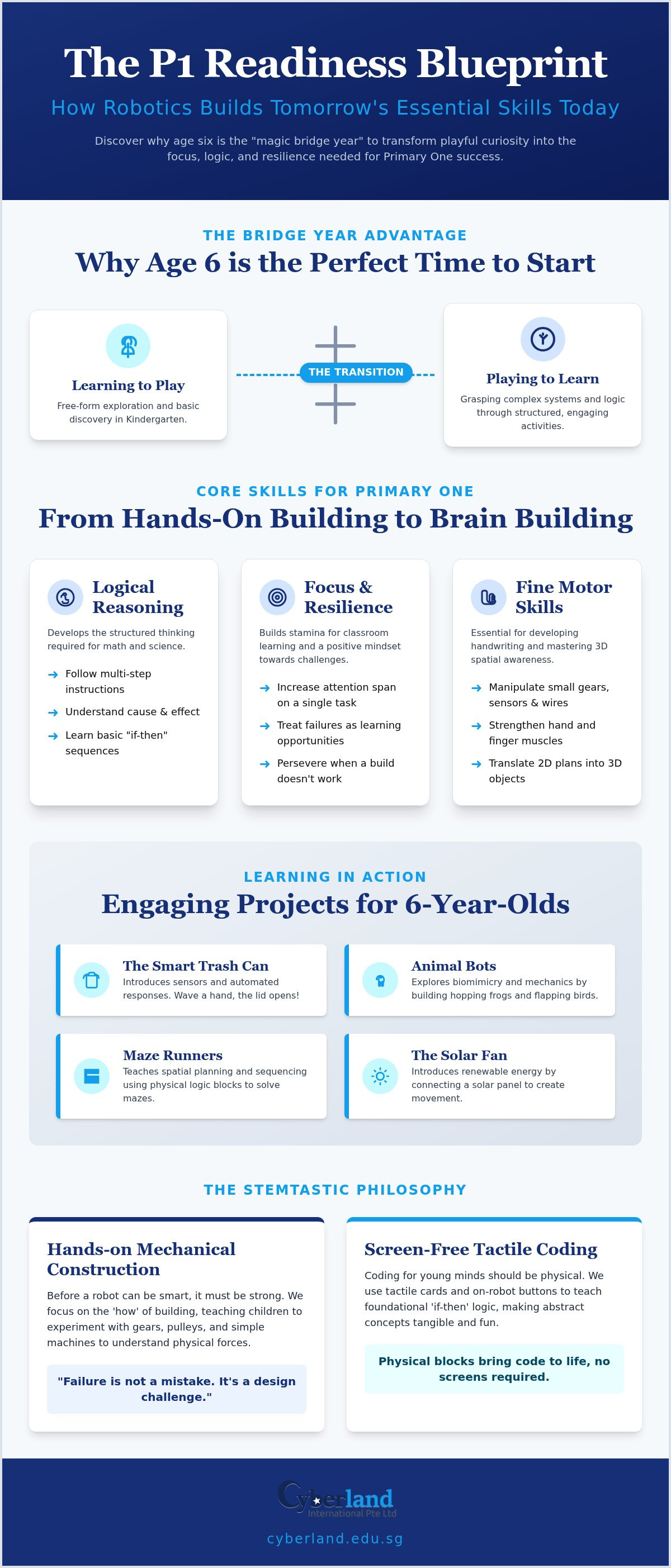
Why 6 is the "Magic Age" to Start Robotic Classes in Singapore
At age six, children undergo a remarkable cognitive shift. They move from "learning to play" to "playing to learn" complex systems. It's a phase where curiosity meets capability. Educational robotics serves as the perfect catalyst for this growth. By enrolling in robotic classes for 6 year olds, your child begins to grasp cause-and-effect sequences in a way that feels like a game, yet builds deep technical intuition. They’re ready for more. They want to know how things work, not just what they do.
The K2 to Primary One Logic Transition
The transition from Kindergarten 2 to Primary One is a significant milestone. It's a jump from free-form play to structured academic expectations. Robotics acts as the "bridge year" for six-year-olds by providing a supportive environment where they can practice the logical thinking and structured inquiry required for formal schooling. This experience prepares them for the rigors of the P1 classroom without the stress of traditional desk work.
Instructional Following: Completing a robot requires following multi-step guides, mirroring how teachers deliver instructions in school.
Focus Stamina: Building a project from start to finish trains a child to stay engaged for longer periods.
Problem-Solving: When a build doesn't work, children learn to pause, think, and try again.
Fine Motor Skills and Spatial Awareness
Physical development is just as crucial at this stage. Six-year-olds are ready to move beyond large, chunky blocks. They're developing the refined dexterity needed to manipulate small gears, tiny sensors, and delicate wires. This hands-on work isn't just about building toys. It's engineering. Every movement helps strengthen the small muscles in their hands, which is essential for handwriting and other school tasks.
When children participate in robotic classes for 6 year olds, they're also mastering 3D spatial reasoning. They learn how components fit together in space. This directly supports early mathematics and geometry. It transforms abstract concepts into something they can touch, turn, and test. By understanding how a flat instruction sheet becomes a three-dimensional moving machine, they build a mental map of the world around them. It’s an exciting journey from a pile of parts to a functional creation.
4 Engaging Examples of Robotic Activities for 6-Year-Olds
Robotic classes for 6 year olds are not about staring at a computer screen. They are vibrant, noisy, and wonderfully tactile environments. At this magic age, children learn best when they can touch, build, and immediately see the results of their work. These classes turn abstract science into a physical playground where every gear turn is a lesson in logic. Here are four projects that ignite that spark of discovery.
The Smart Trash Can: This project introduces the concept of automated responses. Children build a bin that uses an infrared sensor to detect motion. When they wave a hand, the lid pops open. It feels like magic, but it's their first lesson in how sensors interact with the world.
Animal Bots: Kids love nature. By constructing creatures like hopping frogs or flapping birds, they explore biomimicry. They learn how different mechanical joints mimic the movement of living things.
Maze Runners: Using physical logic blocks, children guide a robot through a custom obstacle course. This isn't just a game; it's a lesson in spatial planning and sequence.
The Solar Fan: This project integrates our STEMtastic philosophy with renewable energy. Children connect a solar panel to a motor and watch as sunlight creates movement. It’s a powerful introduction to how technology can solve real-world problems.
Hands-on Mechanical Construction
Before a robot can move, it must be stable. In our Junior Engineer program for kids, we focus on the "how" of building. Six-year-olds experiment with gears, pulleys, and simple machines. They learn that a larger gear makes a smaller one spin faster. They discover that a pulley can lift a heavy load with ease. We treat failure as feedback. If a robot’s arm falls off, we don't call it a mistake. We call it a design challenge. This mindset builds the resilience needed for the Primary One transition. They learn to pause, analyze the structure, and try a different connection.
Introduction to Tactile Coding
Coding for young children should be screen-free and physical. We use tactile coding cards or buttons directly on the robot to teach "if-then" logic. For example, a child might program a robot with a simple rule: "If the sensor sees a red line, then the robot stops." This develops the computational thinking required for our junior programmer course Singapore. By moving physical blocks to create a sequence, children understand that coding is just a set of instructions. It makes the abstract world of software feel tangible and achievable. If you're curious about how these activities can benefit your child, consider exploring our STEMtastic workshops for a hands-on start.
How Robotics Prepares Your Child for Primary One Logic
Logic is the heartbeat of the Primary One curriculum. While traditional subjects focus on "what" to learn, robotic classes for 6 year olds focus on "how" to think. This transition year is the perfect time to introduce computational thinking. Children learn decomposition by breaking a complex build into small, achievable tasks. It transforms an overwhelming challenge into a series of wins. They stop seeing a pile of parts as a problem and start seeing it as a sequence of steps.
Pattern recognition naturally follows. In these robotic classes for 6 year olds, your child will start to identify similarities in how different robots react to sensors. This leads to algorithmic thinking, where they craft a step-by-step "recipe" for their robot to follow. More importantly, they build resilience. When a build doesn't work, they don't give up. They debug. Staying calm when a "code" or "build" has a bug is a vital life skill. This emotional regulation is exactly what they need for a smooth P1 transition.
Aligning with MOE 21st Century Competencies
Singapore’s Ministry of Education (MOE) focuses on 21st-century competencies like critical and inventive thinking. Robotics classes bring these goals into the physical world. We believe that critical thinking for early learners is best developed through open-ended builds. In our workshops, children often work in pairs. This collaboration teaches them to communicate their logic and solve engineering hurdles as a team. They learn to listen, negotiate, and share ideas, which is essential for the collaborative environment of a modern classroom.
Boosting Literacy and Numeracy
Robotics is a secret weapon for literacy and numeracy. Children don't just see numbers on a page; they use them. They measure distances for their maze runners and count motor rotations to control speed. They even begin to understand angles as they program their robots to make precise 90-degree turns. Their vocabulary grows too. They master terms like "torque," "circuit," and "sensor." Robotics transforms abstract math into a physical reality that a child can touch and control. It makes the "hard" parts of school feel like an exciting discovery. It turns numbers into movements and logic into action.
Choosing the Best Robotics Enrichment in Singapore
Finding the right partner for your child's STEM journey is an exciting step. You want a place that feels like a second home for their growing mind. When you evaluate robotic classes for 6 year olds, look beyond the fancy gadgets. Focus on the human element and the curriculum structure. A great center offers a path that grows with your child. It should move naturally from physical construction to basic programming logic. Safety is also paramount. An inspiring, child-safe environment allows kids to explore without limits. Always ask for a trial class. Watching how your child interacts with the tools and the teacher tells you more than any brochure ever could.
Choosing the right robotic classes for 6 year olds means finding a balance. You need a curriculum that challenges them technically while supporting them emotionally. It's about building confidence as much as it's about building robots. When children feel safe to fail, they become bold innovators. They start to see every challenge as a puzzle waiting to be solved. This mindset is the greatest gift an enrichment center can provide.
The Importance of Low Student-Teacher Ratios
Six-year-olds are still developing their fine motor skills. They often need tactile help when connecting small sensors or intricate gears. A low teacher-to-student ratio is vital for this age group. It ensures your child gets the individual attention they deserve. Our mentors don't just provide answers; they guide discovery. When a build gets tough, a mentor is there to help with the "debugging" phase. This reduces frustration and keeps the joy of learning alive. It turns a potential moment of defeat into a triumphant "I did it" realization.
Location and Accessibility for Parents
Convenience matters for busy Singaporean families. Many parents look for centers in established hubs with a strong community feel. If you're exploring preschool enrichment Ang Mo Kio options, accessibility is a major plus. Being located in a central area like Ang Mo Kio Industrial Park 2 makes it easier to fit classes into your weekly schedule. Check if the center offers a mix of regular weekly sessions and intensive holiday workshops. This flexibility ensures your child can keep their momentum going throughout the year. Ready to see the difference for yourself? Book a visit to our Ang Mo Kio center today and watch your child’s curiosity take flight.
Igniting Curiosity with Cyberland’s Junior Programs
At Cyberland, we believe every child is a natural-born innovator. Our robotic classes for 6 year olds are designed to harness that raw curiosity. We offer two specialized pathways: Junior Engineer and Junior Programmer. The Junior Engineer module is a hands-on adventure. It focuses on the physical mechanics of building. Children learn how gears lock and how structures stay strong. Meanwhile, our Junior Programmer course introduces coding logic through visual, often screen-free methods. It's a perfect match for six-year-olds who are ready to explore the "why" behind the "how."
Our "STEMtastic" philosophy is the heartbeat of everything we do. We make science and technology accessible through the power of play. It’s about creating high-energy environments where technology feels like a toy, not a chore. We partner with local preschools and primary schools across Singapore to bring these workshops to life. Whether your child joins us for an individual enrollment at our Ang Mo Kio center or through a school-based session, they enter a world of wonder. We are committed to nurturing the next generation of thinkers, one robot at a time.
The Cyberland Mentor Approach
Our teachers are more than just instructors. They are friendly guides. We don't just lecture; we ignite passion. Every session is crafted to create a sense of wonder and possibility. We focus on the positive trajectory of your child’s development. If they struggle with a connection, we cheer for their persistence. If they solve a puzzle, we celebrate their brilliance. This supportive atmosphere helps children build the technical confidence they need for Primary One and beyond. It turns a classroom into a community of young explorers.
Next Steps for Your 6-Year-Old
The best way to understand the Cyberland difference is to see it in action. We invite you to book a discovery session today. Watch your child’s eyes light up as their first creation moves. For parents looking at the long-term horizon, we recommend exploring our Singapore Primary School Robotics: 2026 Buying Guide. It offers deep insights into planning your child's STEM journey through their primary years. It helps you see the big picture while your child enjoys the small, joyful moments of discovery.
Your child is ready for this. They have the curiosity. They have the imagination. Now, they just need the right environment to let it flourish. Let's start this journey together. The future is waiting, and it's going to be STEMtastic. Reach out to us to find the perfect fit for your little engineer.
Build a Future Full of Possibility
Choosing the right robotic classes for 6 year olds is about more than just building gadgets. It's about giving your child the technical confidence to tackle the logic of Primary One with a sense of adventure. You've seen how these programs transform abstract numeracy into physical discovery and how the "bridge year" develops essential focus stamina. By prioritizing low student-teacher ratios and hands-on engagement, you're setting a solid foundation for lifelong resilience and critical thinking.
As a trusted partner of Singapore schools, Cyberland is here to guide that growth every step of the way. Our expert mentors in early childhood STEM create a nurturing space where every "bug" is just a puzzle waiting to be solved. Conveniently located in Ang Mo Kio Industrial Park 2, we provide a high-energy environment that makes learning feel like pure discovery. It's time to turn that natural wonder into a trajectory of success.
Spark your child’s curiosity—explore Cyberland’s Junior Programs today!
The world of 2026 is full of wonder. We can't wait to see what your little engineer will build next.
Frequently Asked Questions
Is a 6-year-old too young to start learning robotics?
Six is actually the ideal age to begin because children at this stage possess the fine motor skills and cognitive curiosity to explore complex systems. They're naturally moving from simple play to understanding how things work. Robotic classes for 6 year olds leverage this developmental window to introduce engineering concepts through tactile building. It isn't about complex math yet; it's about seeing a motor turn a wheel they just attached.
What is the difference between coding and robotics for preschoolers?
Robotics focuses on the physical construction of a machine using gears, sensors, and motors. It's highly tactile and mechanical. Coding is the set of instructions that tells that machine what to do. For young learners, we often use physical coding blocks or buttons to bridge this gap. While robotics is about the "body" of the machine, coding is about the "brain" and the logic behind its movements.
Will my child spend the whole class looking at a tablet or screen?
Not at all. We prioritize "unplugged" learning for our younger students to minimize screen time. Most of the session involves hands-on building with physical components like blocks and gears. When we do introduce programming, it's often through tactile methods like physical coding cards or buttons on the robot itself. This ensures that your child remains engaged with the physical world while developing the logical reasoning skills needed for digital literacy.
How does robotics help with my child’s Primary One preparation?
Robotics acts as a bridge to the structured environment of Primary One. It trains children to follow multi-step instructions and build the focus stamina required for a classroom setting. By breaking down a build into smaller steps, they practice "decomposition," a key part of computational thinking. This hands-on approach also makes abstract numeracy and literacy concepts tangible, giving them a head start in logical reasoning before they even enter the school gates.
What should my child bring to their first robotics class?
Your child only needs to bring their natural curiosity and a water bottle to stay hydrated during the high-energy sessions. We provide all the necessary kits, sensors, and building components for our Junior Engineer and Junior Programmer modules. There’s no need to purchase expensive equipment or software beforehand. We recommend comfortable clothing that allows them to move freely as they test their robots on the floor or at building stations.
Can robotics help a child who has difficulty focusing?
Yes, robotics is incredibly effective for children who struggle with traditional focus. The immediate physical feedback of seeing a robot move or light up provides a powerful incentive to stay engaged. Because the activities are hands-on and project-based, children often find themselves "lost" in the task. This helps them build concentration in a way that feels like play, gradually extending their ability to stick with a challenge until it's solved.
Are there any competitions for 6-year-olds in Singapore?
While many major competitions target older students, there are several "Junior" categories and friendly showcases designed specifically for younger innovators. These events focus on participation and creativity rather than intense pressure. Participating in robotic classes for 6 year olds at Cyberland helps prepare children for these future opportunities. It builds the technical confidence and presentation skills they'll eventually need for more advanced national challenges and future school admission pathways.
How long are the robotic classes at Cyberland?
Our sessions are carefully timed to match the energy levels and attention spans of young learners. Typically, a standard session for our Junior Engineer or Junior Programmer modules lasts between 1.5 to 2 hours. This provides ample time for an introductory concept, the hands-on building phase, and a final "play and test" period. We ensure the pace is brisk and purposeful, keeping every child excited and moving through the discovery process without feeling overwhelmed.
Comments