
Early Childhood Coding Workshops: A Parent's Guide to Playful Programming
- Daniel Chua
- Aug 8
- 11 min read

What if the best way to prepare your child for a high-tech future didn't involve a screen at all? Many parents in Singapore feel the pressure to build logic and reasoning skills before Primary One. Yet, the fear of excessive screen time is real. You might be searching for early childhood coding workshops that offer more than just digital distraction. It's a common struggle to distinguish between 'playing games' and 'building a foundation' for the future.
This guide shows you how playful programming transforms technology from something kids consume into something they create. You'll discover the vital difference between consumer-tech and creator-tech. We'll explore how hands-on, screen-lite activities build logic, creativity, and problem-solving skills. By the end, you'll know how to choose a workshop that balances cognitive development with the simple joy of discovery. Let's prepare your child for digital literacy through the power of play.
Table of Contents
What Are Early Childhood Coding Workshops Really About?
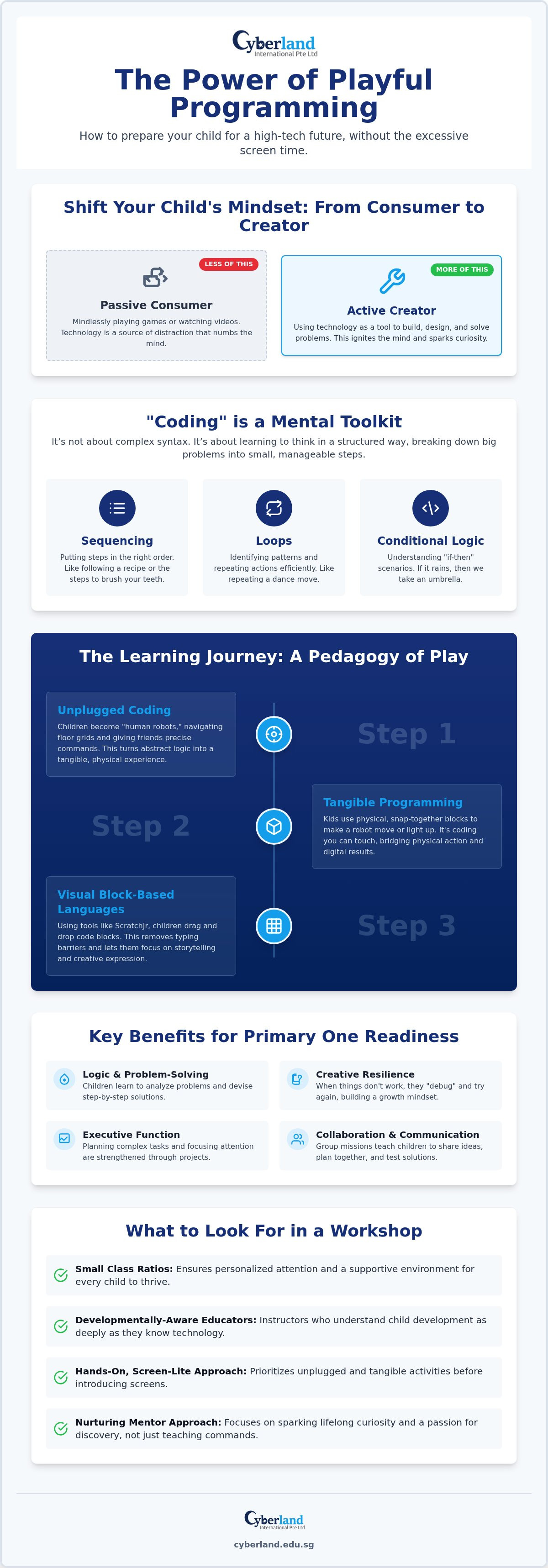
Forget the image of a child hunched over a glowing laptop. In the context of early childhood coding workshops, "coding" is actually a shorthand for computational thinking. It's a mental toolkit. It teaches young minds to break down big, scary problems into tiny, manageable steps. This isn't just about preparing for a future career; it's about shifting from being a digital consumer to a digital creator. In Singapore, our Smart Nation initiative recognizes that this mindset starts in the preschool years. By the time children reach Primary One, they shouldn't just know how to swipe on an iPad. They should understand the logic that makes the magic happen.
For non-techies, the core components of these workshops are surprisingly simple:
Sequencing: Putting steps in the right order, like the steps to brush your teeth.
Loops: Identifying patterns and repeating actions, like a dance move.
Conditional Logic: Understanding "if-then" scenarios. If it rains, then we take an umbrella.
Breaking the Myth: Coding vs. Screen Time
Many parents worry about "more screens," but high-quality workshops often start with zero screens. They use "unplugged" activities. Children might use their own bodies to navigate a floor grid or use physical cards to "program" a friend to walk across the room. This physical movement is vital. It turns abstract logic into a tangible experience. There's a massive difference between passive video consumption and active tech creation. One numbs the mind; the other ignites it. It's about using technology as a tool for expression rather than a source of distraction.
The Literacy of Logic for Preschoolers
Think of coding as a new spoken language. Just as children soak up vocabulary, they can also absorb the "literacy of logic." These workshops are grounded in established theories of child development, ensuring that every activity matches a preschooler's cognitive stage. By building these "logic muscles" early, kids are better prepared for the rigors of Primary One math and science. They don't just learn to find the right answer. They learn a growth mindset. When a sequence doesn't work, they don't give up. They "debug" it. They try again. That resilience is the real prize.
How Early Childhood Coding Workshops Work: The Pedagogy of Play
Think big. Code small. Effective early childhood coding workshops don't just throw kids into the deep end. They follow a gentle, scaffolded roadmap. This journey ensures that every child feels successful and supported. It's about building confidence one block at a time. This structured approach is backed by research on playful learning for teaching coding, which highlights how engagement peaks when children explore concepts through hands-on discovery. They aren't just memorizing commands; they're learning to think.
Unplugged Coding: Learning Without a Computer
Before touching a screen, children become 'human robots.' One child gives instructions; the other follows them exactly. This game reveals why computers need precise commands. If you forget to say 'turn left,' your robot walks into a wall! This stage builds essential spatial awareness as kids map out paths across floor grids. In many early childhood coding workshops, this is the most energetic part of the day. Unplugged coding is a foundational pedagogical tool for ages 4-6 that teaches computational logic through physical, non-digital activities.
After the physical games, children move to tangible programming tools like robotic blocks. These are physical cubes that snap together with a satisfying click to make a robot move or light up. It's coding you can touch. It bridges the gap between a physical action and a digital result. This tactile experience is crucial for developing fine motor skills alongside logical thinking. It turns abstract concepts into something they can hold in their hands.
Visual Programming: The Power of Blocks
Once the logic is firm, children transition to visual, block-based languages like ScratchJr. These platforms use drag-and-drop blocks. This removes the barrier of typing and spelling. It allows a 4-year-old to focus on the 'why' rather than the 'how.' Visual cues help them see the program's flow instantly. It's not just math; it's storytelling. They create animations and games, turning abstract ideas into vibrant, moving art. This creative expression keeps them coming back for more.
The final stage is collaborative missions. Children work in small groups to solve a specific challenge. Maybe they need to 'code' a robot to deliver a package across a map. They talk. They plan. They test. This project-based learning mirrors real-world engineering. It fosters teamwork and communication. If you're looking for a way to start this journey, consider exploring a Junior Programmer module to see these steps in action.
The Developmental Benefits of Early Coding Workshops
Growth happens when curiosity meets structure. While the technical skills are impressive, the impact of early childhood coding workshops is profound because it touches every aspect of a child's development. It's not just about the screen. It's about the child. These sessions act as a catalyst for cognitive, social, and physical milestones. They provide a safe space to explore, fail, and succeed. Every "bug" fixed is a confidence boost. Every project completed is a testament to their growing persistence.
Cognitive Growth: Beyond the Computer
Coding logic is deeply connected to literacy and pattern recognition. When a child identifies a repeating sequence in a program, they're using the same mental muscles required to recognize phonics or mathematical patterns. This algorithmic thinking translates directly into everyday decision-making. It helps them understand cause and effect in the world around them. Early childhood coding workshops build executive function by challenging children to organize sequences, manage their focus, and adapt their plans in real-time. This mental agility is a vital foundation for the transition to Primary One, where complex multi-step tasks become the norm.
Social and Emotional Learning (SEL)
Teamwork is the heart of innovation. Many workshops utilize a "pair programming" model, where children take turns being the "driver" and the "navigator." This setup teaches vital communication skills. They learn to listen, negotiate, and share credit for success. Perhaps most importantly, it transforms their relationship with failure. In a coding environment, a mistake isn't a dead end; it's just a "bug" that needs a solution. This mindset shift is powerful. It turns "I can't do it" into "Let me find the bug." Participating in early childhood coding workshops provides a unique space to celebrate diverse solutions to the same challenge, showing kids that there are many paths to success.
Physicality plays a huge role in these early years. Hands-on engineering components, like those found in Junior Engineer modules, refine fine motor skills. Snapping blocks together or connecting tactile sensors requires precision and coordination. These activities bridge the gap between abstract thought and physical reality. When children build a physical structure and then "bring it to life" with code, they see themselves as capable creators. They aren't just using tech; they're mastering it. This sense of agency is the ultimate developmental benefit, sparking a lifelong passion for discovery and growth.
Choosing the Right Coding Workshop in Singapore
Finding the perfect match for your child is a journey of trust. You aren't just looking for a classroom; you're looking for a launchpad. In a city where enrichment options are everywhere, focus on the environment first. A nurturing space allows a child to feel safe while they experiment. Class size matters. A lot. For a 4-year-old, a low instructor-to-student ratio is essential. It ensures that every "why" is answered and every small victory is celebrated. Small groups allow mentors to pivot the lesson based on a child's unique energy that day.
Qualifications should go beyond technical expertise. Seek educators who understand child development milestones as deeply as they know computer logic. A teacher who knows how a preschooler's mind works can turn a complex sequence into an engaging story. The curriculum must also be balanced. High-quality early childhood coding workshops should offer a rhythmic mix of physical play and digital exploration. Location is the final piece of the puzzle. Finding a reliable center in a community hub like Ang Mo Kio makes regular enrichment sustainable for busy Singaporean families.
What to Ask the Workshop Provider
Don't be afraid to dig deeper. Ask potential providers these specific questions to ensure the fit is right for your family:
Do you prioritize screen-free, unplugged activities for the younger age groups?
How do you tailor the pace for children who are still developing their literacy and fine motor skills?
What tangible take-homes or progress reports do you provide so I can support my child's growth at home?
Preparing for Primary One Readiness
Singapore's Smart Nation vision isn't just for adults. It starts in the preschool years. These workshops align perfectly with the Ministry of Education's (MOE) focus on critical thinking and 21st-century competencies. By introducing these concepts early, you're bridging the gap between kindergarten play and the structured logic of primary school. It builds the "mental stamina" required for Primary One math and science. For a comprehensive look at the landscape, you can browse this Top Coding Schools for Kids in Singapore: 2026 Guide. Choosing the right early childhood coding workshops today creates a foundation of digital literacy that lasts a lifetime. If you're ready to see how a nurturing mentor can spark your child's potential, you can explore our Junior Programmer modules to find the perfect start.
Igniting Curiosity: The Cyberland Junior Programmer Approach
Every child is a natural explorer. At Cyberland, we don't just teach technical skills; we ignite a lifelong passion for discovery. Our "nurturing mentor" philosophy means we guide children through their first digital steps with patience and warmth. We've been a staple in Singapore's enrichment sector for over two decades. This deep experience allows us to craft early childhood coding workshops that resonate with young learners. We believe in building a supportive partnership with parents to ensure every child feels seen, heard, and encouraged.
Our approach goes beyond the screen. We blend technical literacy with the joy of physical play. In our STEMtastic workshops, children see the bridge between science and engineering. They don't just code a robot to move; they explore the mechanics of why it happens. It's an interactive, multi-sensory experience that makes complex concepts feel like second nature. By the time they finish a session, they aren't just users of technology. They are confident creators who understand the world around them.
Junior Programmer: Building Foundations
The Junior Programmer modules are designed specifically for early learners. They are tactile. They are visual. Above all, they're fun. We focus on hands-on activities that spark immediate interest. Whether it's using colorful blocks to build a logical sequence or navigating a digital world, the engagement is instant. We're committed to small class sizes. This ensures that every child receives personalized encouragement from our mentors. If you want to see how we blend logic with physical building, explore our Junior Engineer Programs for Kids: 2026 Guide. These programs provide the perfect complement to our early childhood coding workshops by focusing on hardware and engineering.
Partnering for Success
We believe that high-quality enrichment should be accessible to all. That's why Cyberland actively partners with local preschools and primary schools across Singapore. We bring our interactive modules directly into the classroom, supporting educators in delivering cutting-edge tech literacy. These partnerships allow us to reach more children and help schools stay ahead of the digital curve. We invite school administrators to experience the energy of our STEMtastic workshops and see how we can enrich their curriculum.
Ready to spark your child's potential? Visit us at our vibrant learning hub in Ang Mo Kio Industrial Park 2. We're here to be your reliable guide in this exciting journey. Whether your child starts with Junior Programmer or dives into STEMtastic, we promise an environment filled with wonder and growth. Let's build their future together, one playful program at a time.
Building a Future of Playful Discovery
The journey from digital consumer to confident creator begins with a single spark of curiosity. High-quality early childhood coding workshops offer much more than technical skills. They provide a vital foundation of logic, resilience, and creative problem-solving. By choosing a path that prioritizes the pedagogy of play, you're giving your child the mental stamina needed for Primary One and the digital literacy required for a Smart Nation future.
At Cyberland, we've spent over 20 years partnering with Singapore schools to nurture the next generation. Our specialized Junior Programmer and STEMtastic modules are led by nurturing instructors trained specifically in early childhood engagement. We don't just teach code; we act as a reliable guide for your child's growth. Spark your child's curiosity with Cyberland's Junior Programmer workshops today! The world of tomorrow is full of wonder, and your child is ready to create it.
Frequently Asked Questions
Is my 4-year-old really ready to learn coding?
Absolutely. At age four, children are in a prime developmental stage for understanding sequences and cause-and-effect. These workshops focus on foundational logic skills rather than typing complex text. It's about teaching them how to think through a problem step-by-step using games and stories. We make abstract concepts tangible. This sets a joyful, pressure-free foundation for all their future technical learning and academic growth.
Will my child spend the whole workshop staring at a screen?
Not at all. High-quality sessions for this age group prioritize "unplugged" activities that involve physical movement and tactile blocks. We believe in a screen-lite approach. Children often spend time navigating floor grids or snapping together robotic cubes. Screens are only introduced as a tool for visual storytelling once the underlying logic is firm. This balance keeps the experience energetic, social, and healthy.
What is the difference between a coding workshop and a robotics class?
Coding focuses on the "brain" or the logical instructions that tell a machine what to do. Robotics involves the "body," which includes building and engineering the physical machine. Many of our STEMtastic sessions combine both. This helps children see the immediate physical result of their logical thinking. Understanding how hardware and software work together provides a more holistic view of how modern technology actually functions.
How do coding workshops help with Primary One preparation in Singapore?
These workshops build the mental stamina and executive function required for the Primary One curriculum. Singapore's Ministry of Education emphasizes critical thinking and 21st-century competencies. By learning to "debug" a sequence or plan a multi-step task, children develop the resilience needed for primary school math and science. It bridges the gap between kindergarten play and the structured reasoning they'll encounter in formal classrooms.
Do I need to have a computer at home for my child to practice?
You don't need any special equipment at home. At this age, the best practice is actually "unplugged." You can encourage logical thinking by asking your child to give you "precise instructions" for daily tasks like making a sandwich or tidying up toys. This reinforces the concept of sequencing without needing more screen time. The goal is to build a mindset, not to master a specific device.
What happens if my child finds the logic too difficult?
We believe there are no mistakes, only "bugs" to solve. Our nurturing mentors are trained to pivot the pace based on each child's individual needs. If a concept feels tricky, we break it down into even smaller, more playful steps. We use storytelling and physical games to make the logic feel like a natural part of the fun. Every child progresses at their own speed.
Can coding workshops improve my child's math skills?
Yes, there's a strong link between coding logic and mathematical reasoning. Identifying patterns, understanding variables, and developing spatial awareness are all core parts of early childhood coding workshops. These skills translate directly to better performance in numeracy. When children learn to visualize a problem and break it into parts, they're practicing the same logic used in high-level math and scientific inquiry.
How long does it typically take to see progress in a child's logical thinking?
You'll likely see a spark of curiosity after the very first session. However, deeper shifts in logical thinking and resilience usually become visible over a full term of eight to ten weeks. You might notice your child becoming more patient when solving puzzles or more precise when explaining their ideas. This steady growth builds a confident foundation that prepares them for future digital literacy and long-term success.


Comments