
Engineering for Singapore Preschoolers: 2026 Guide

What if your child’s favorite block tower wasn’t just play? What if it was the first step toward mastering the logic needed for Primary One? It’s a question many parents ask as they explore engineering for preschoolers Singapore for the 2026 school year. You want your child to be ready. You feel the pressure of the local education system. It’s natural to worry about them falling behind in STEM or to feel confused about whether play is actually learning.
We understand that transition. It’s why early engineering has become such a vital bridge for young learners. It isn’t about complex math. It’s about the joy of discovery. Spark wonder. Build confidence. This guide helps you turn natural curiosity into structured problem-solving skills. You’ll see your child grow more confident with hands-on tools and logical concepts. We’ll explore the latest ECDA trends, the benefits of specialized Junior Engineer modules, and how to prepare your little builder for the challenges of P1 and beyond. Together, we can ensure they step into that first classroom with a builder’s mindset and a love for learning.
Table of Contents
What Exactly is Engineering for Preschoolers?
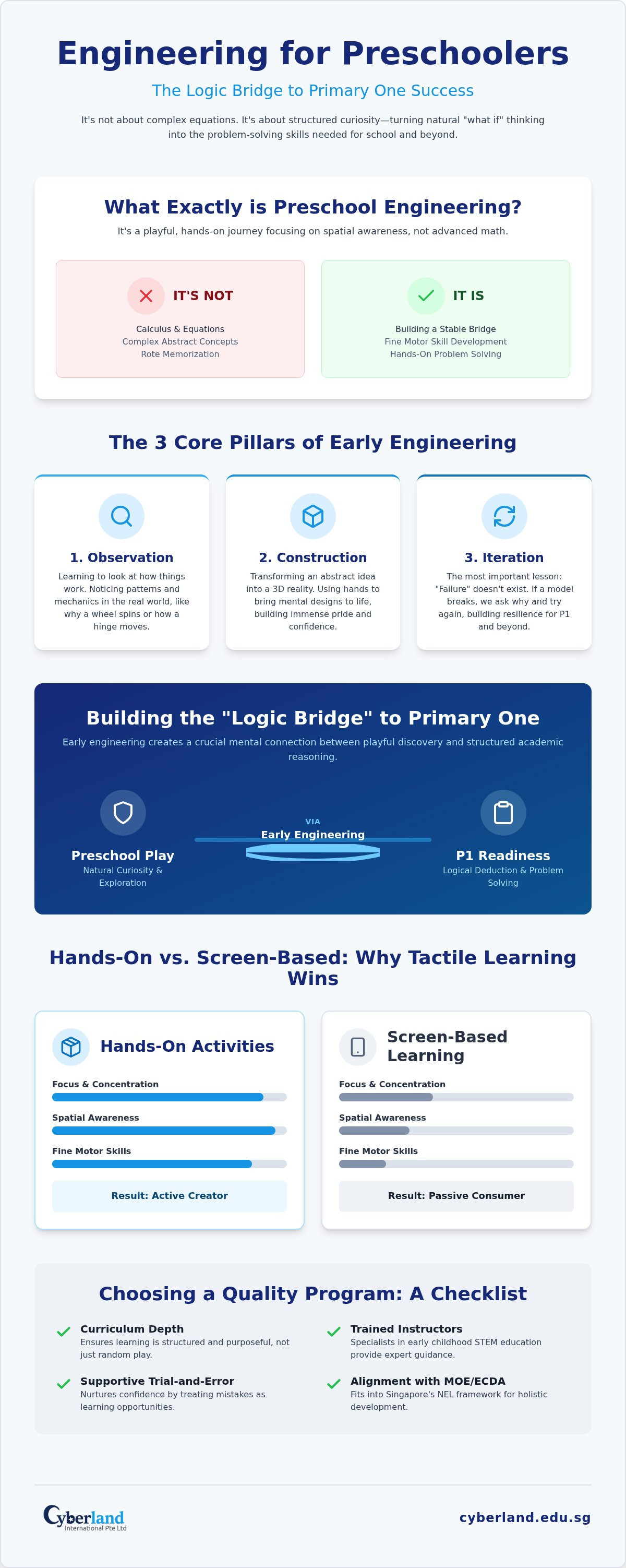
Engineering for preschoolers Singapore isn’t about complex equations or heavy textbooks. It is a form of structured curiosity. It is a playful, hands-on journey where children identify a problem, design a solution, and test their results using tangible materials. At this age, engineering focuses on spatial awareness rather than advanced math. It’s about understanding how things fit together in a physical space. Simply put, preschool engineering is the application of "what if" thinking to physical objects. This trial-and-error process helps children feel comfortable with uncertainty. They learn that searching for a solution is just as fun as finding one. Spark wonder. Build confidence.
Is Engineering Too Advanced for a 4-Year-Old?
Many parents worry that engineering is too complex for a young child. Let’s debunk that myth. Engineering for a 4-year-old isn’t calculus. It is building a stable bridge with wooden blocks. Young minds are naturally wired for this. They constantly ask "why" and "how" as they explore their surroundings. When a child tries to figure out why a tower keeps falling, they are acting as a junior engineer. This mechanical exploration also helps develop essential fine motor skills. They learn to grip, balance, and align pieces with precision. Watch them grow. See them shine.
The Core Pillars of Early Engineering Education
Effective programs align with global early childhood education principles by focusing on three main pillars. These pillars ensure that the learning is both age-appropriate and impactful for future development.
Observation: This is about learning to look at how things work in the real world. Why does a wheel spin? How does a hinge move? Children learn to notice patterns and mechanics in their everyday lives.
Construction: This stage transforms an abstract idea into a three-dimensional reality. Children use their hands to bring their mental designs to life. It involves selecting the right materials and understanding weight distribution. This builds immense pride and confidence.
Iteration: This is perhaps the most important lesson. In engineering, "failure" doesn't exist. It is just a step in the design process. If a model breaks, we ask why and try again. This builds the resilience needed for the Primary One transition.
By focusing on these pillars, we help children build a foundation of resilience and logic. They stop seeing mistakes as setbacks. Instead, they see them as puzzles waiting to be solved. This mindset is what prepares them for more advanced STEM concepts later in their school journey. It is about creating a "builder's mindset" that stays with them for life.
Why Early Engineering is Vital in the Singapore Education Context
Singapore’s education landscape is shifting toward innovation. Engineering for preschoolers Singapore is no longer just a "nice-to-have" enrichment; it’s a strategic foundation for life. The Ministry of Education (MOE) champions the "Nurturing Early Learners" (NEL) framework. This framework emphasizes holistic development and active discovery. Engineering fits perfectly. It encourages children to be curious, active, and competent learners. By aligning with the standards set by Singapore's Early Childhood Development Agency (ECDA), quality programs ensure that play remains purposeful. It isn't just about building towers. It's about building with intent. Spark curiosity. Ignite passion.
We are preparing children for a future-ready Singapore workforce. This preparation starts as early as the nursery level. Singapore values 21st Century Competencies like critical thinking and inventive thinking. Engineering provides the perfect training ground. It challenges children to look beyond the surface of a toy. They learn to ask: "How can I make this stronger?" or "Why did this fall?" This mindset shift is vital. It moves them away from passive consumption toward active creation. It’s about empowerment. It’s about growth.
Preparing for Primary One Logic and Reasoning
The jump to Primary One is a significant milestone. Engineering builds the "Logic Bridge" needed for this leap. We know that critical thinking for early learners begins with physical exploration. Instead of rote memorization, children engage in active logical deduction. They learn to sequence steps. They predict outcomes based on physical evidence. This builds the mental stamina required for the complex problem-solving they will face in P1. It’s about more than grades. It’s about the confidence to say, "I can solve this."
Developing Spatial Awareness and Executive Function
Engineering is a full-brain workout. Through our Junior Engineer projects, children develop exceptional spatial awareness. They learn to visualize 3D objects and understand complex rotations. This is a direct precursor to mathematical reasoning and geometry. Building a complex structure requires high levels of focus. This strengthens executive function. It teaches them to stay goal-oriented even when things get tricky. They learn to manage their materials and their time. It’s about building the brain’s capacity for deep, analytical thought. If you want to see your child develop these vital skills, our Kindergarten Enrichment programs offer a nurturing space for this growth.
Hands-On vs. Screen-Based: Finding the Right Balance
With 98.4% of Singaporean households owning mobile devices, our children are growing up in a digital-first world. While digital literacy is essential in our Smart Nation, the way we introduce technology to young children matters deeply. Engineering for preschoolers Singapore should focus on active creation rather than passive consumption. When a child simply watches a video, they are consuming. When they build a physical model, they are innovating. Real engineering happens in the hands, not just on a tablet.
Tactile learning is superior for brain development in children aged 4 to 6. It engages multiple senses at once, which helps cement new concepts. This approach aligns perfectly with the Nurturing Early Learners (NEL) Framework, which emphasizes purposeful play and sensory exploration. By touching, moving, and connecting physical parts, children develop a deeper understanding of mechanics and physics. They don't just see how a lever works; they feel the resistance and the pivot. Build. Create. Grow.
The Power of Tactile Problem-Solving
Using physical blocks and gears allows children to understand mechanical advantage in a way no screen can replicate. They learn how different sizes of gears affect speed and power through direct experimentation. This sensory-rich learning reinforces memory. It turns abstract ideas into concrete knowledge. There is also a massive boost in confidence when a child achieves a tangible result. They can touch their creation. They can show it to their parents with pride. It makes the learning journey feel real and rewarding.
When to Introduce Technology and Coding
Technology has a place when used as a tool for creation. Our Junior Programmer course Singapore uses an "unplugged" approach to start. We teach the logic of coding through physical games and movement before moving to a screen. This ensures children understand the "why" behind the code. Once they have the physical foundation, we transition to digital logic in a structured, age-appropriate way. We use tech to control the physical robots they have built. This creates a bridge between the digital and physical worlds. It ensures they remain active creators who use technology to solve real-world problems.
What to Look for in a Singapore Preschool Engineering Program
Choosing the right environment for engineering for preschoolers Singapore is a vital step in your child's developmental journey. It’s about more than just finding a classroom. You are looking for a partner. A mentor. A guide. Start by evaluating the curriculum depth. Does the program move beyond just "playing with toys"? A high-quality program uses physical models to teach real mechanics and structural integrity. Demand structured learning. Look for a clear progression that grows with your child’s abilities. Spark wonder. Build confidence.
When searching for engineering for preschoolers Singapore, consider the provider's track record. Instructor expertise is non-negotiable. Ensure the educators are specifically trained in early childhood STEM education. They should understand both the science and the child. Trust is also built through school partnerships. When a provider works closely with established Singaporean schools, it shows institutional credibility. Location matters too. A local hub in Ang Mo Kio Industrial Park 2 provides community trust and easy accessibility for busy families. It’s about convenience and quality combined.
Evaluating Local vs. International Providers
Local providers often have a distinct advantage. They understand the nuances of the Singapore school system perfectly. They know exactly what logic and reasoning skills are expected during the transition to Primary One. Look for a curriculum tailored to the specific needs of Singaporean parents. It should offer a seamless path from Nursery Enrichment to Kindergarten Enrichment. This continuity ensures your child never feels overwhelmed as they progress. They don't just learn; they thrive. They don't just build; they excel.
The Importance of Hands-On 'STEMtastic' Workshops
True learning is active. High-quality STEM enrichment programs Singapore must be interactive. Evaluate the quality of the tools used in the classroom. Are the materials durable? Are they designed for small hands? The best workshops, like our STEMtastic sessions, foster a genuine sense of wonder. They turn a simple lesson into a thrilling discovery. We believe in using top-tier materials to inspire the next generation of builders. If you are ready to see this magic in action, explore our Junior Engineer modules today. We are here to help your child ignite their passion for discovery.
Igniting Curiosity with Cyberland’s Junior Engineer Modules
Engineering for preschoolers Singapore is more than a curriculum. It’s a journey that begins with a single block and leads to a lifetime of innovation. At Cyberland, we see every child as a bold innovator. Our Ang Mo Kio Industrial Park 2 center serves as a vibrant hub for STEM excellence. We believe that the right environment can transform a child's natural curiosity into a powerful tool for learning. It's about providing the space, the tools, and the encouragement they need to explore the world around them. Spark wonder. Build confidence. Watch them shine.
Our specialized modules are designed to grow with your child. We offer a clear progression that ensures they are always challenged but never overwhelmed. You can explore the full range of our Junior Engineer programs for kids to see how we tailor our approach for different age groups. While our Nursery Enrichment focuses on basic shapes and sensory building, our Kindergarten Enrichment dives deeper into mechanics and structural stability. This structured path ensures that every child develops the logic and reasoning skills they need to thrive in Primary One. They don't just learn about engineering; they become engineers.
Our Unique 'STEMtastic' Approach
We blend professional educational authority with a warm, nurturing atmosphere. This is the heart of our STEMtastic approach. We focus on the joy of discovery in every single module. Learning shouldn't feel like a chore. It should feel like an adventure. By using active, aspirational language, we ignite a lifelong passion for STEM. Our instructors aren't just teachers; they are mentors who guide children through the design process. They encourage questions. They celebrate "failed" attempts as learning milestones. It’s about creating a safe space where curiosity has no limits.
Partnering for Success: Schools and Parents
We know that a child's education is a collaborative effort. That’s why we partner with local preschools to bring world-class engineering directly into the classroom. These partnerships are a sign of the institutional trust we have built within the Singapore education community. But the journey doesn't end when the workshop is over. We provide resources for parents to continue the engineering journey at home. Simple activities like building a cardboard bridge or observing how a door hinge moves can reinforce what they learn with us. Join the Cyberland community and watch your child's curiosity grow. We are here to support you every step of the way as you prepare your little one for a bright, future-ready path.
Building a Future-Ready Mindset Today
The journey from a simple block tower to a Primary One classroom is paved with curiosity and logic. We have explored how engineering for preschoolers Singapore transforms play into a powerful tool for cognitive development. By choosing tactile, hands-on experiences over passive screen time, you give your child the spatial awareness and resilience they need to excel. It is about more than just building. It is about fostering a "builder's mindset" that sees every challenge as a puzzle to be solved. Spark wonder. Build confidence.
As a trusted partner of Singapore schools, we are committed to nurturing the next generation of innovators. Our specialized Junior Engineer modules bridge the gap between nursery play and academic reasoning. Based in Ang Mo Kio Industrial Park 2, we provide a supportive environment where your child can experiment, iterate, and grow. Every small success builds the foundation for a lifetime of discovery. We are here to guide them every step of the way.
Ignite your child's curiosity—Discover Cyberland's Junior Engineer programs today!
The future is bright. Let's build it together.
Frequently Asked Questions
Is engineering suitable for 4-year-olds who can't read yet?
Yes, it's perfectly suitable. Our engineering for preschoolers Singapore modules focus on visual and tactile learning rather than text-heavy instruction. We use physical objects and simple mechanics to teach core concepts. Children learn through doing and observing, which is ideal for their developmental stage. Reading isn't a prerequisite for building a stable bridge or understanding how a gear turns. We use symbols and hands-on guidance to spark wonder. Build skills. Watch them grow.
How do engineering classes help with Primary One preparation in Singapore?
These classes build a vital "Logic Bridge" for the transition to Primary One. By moving beyond rote memorization, children develop active logical deduction and critical thinking. They learn to sequence steps and predict outcomes. These are key 21st-century competencies valued in Singapore’s education system. This foundation gives them the mental stamina and confidence to handle the complex problem-solving they'll encounter in a primary school environment. It’s about being ready for success.
What is the difference between a normal playgroup and an engineering enrichment class?
While normal playgroups focus on general social interaction, our engineering enrichment provides "structured curiosity." Every session has a specific goal, such as identifying a structural problem and designing a physical solution. We use specialized materials to teach mechanics and spatial awareness. This purposeful play turns natural curiosity into a builder's mindset. It’s the difference between just playing with blocks and understanding the physics that keep them standing. Ignite their passion for discovery.
Will my child need to use a computer or tablet in every engineering session?
No, they won't. We prioritize tactile, hands-on learning because real engineering happens in the hands. Most sessions focus on physical materials like gears, blocks, and simple machines. While we do offer digital modules like Junior Programmer, we use an "unplugged" approach first. This ensures children understand the logic behind the technology. We treat devices as tools for creation rather than just screens for passive consumption. Build. Create. Innovate. Spark wonder.
How long are the Junior Engineer modules at Cyberland?
Our Junior Engineer modules are structured to provide a clear progression through different levels of complexity. We offer specialized sessions for both Nursery Enrichment and Kindergarten Enrichment. These sessions are designed to keep young minds engaged without feeling overwhelmed. For the most up-to-date information on session lengths and our current workshop schedules at Ang Mo Kio, please contact us directly. We tailor our delivery to meet the specific needs of our school partners.
Can engineering enrichment help a child who is shy or quiet?
Absolutely. Engineering provides a wonderful non-verbal outlet for creativity and expression. When a quiet child builds a working model, they gain immense confidence through tangible results. They don't have to be the loudest in the room to be a brilliant innovator. Seeing their ideas come to life builds self-esteem. They feel a sense of pride when showing their creations to parents and peers. It’s about finding their unique voice through building.
What kind of materials do children use in a preschool engineering workshop?
We use high-quality, durable materials designed specifically for small hands. This includes specialized building blocks, gears, pulleys, and simple mechanical parts. These physical tools allow children to feel the resistance, weight, and balance of their structures. Using real-world materials makes the learning feel authentic and exciting. It turns a classroom into a vibrant workshop where every child can feel like a professional Junior Engineer. Spark wonder with every piece they connect. Watch them shine.
Are these programs aligned with the MOE NEL framework?
Yes, our programs are closely aligned with the Ministry of Education’s Nurturing Early Learners (NEL) framework. We focus on inquiry-based learning and holistic development. By encouraging children to ask "why" and "how," we support the framework’s goal of developing active and competent learners. Our workshops also foster the 21st-century competencies needed for success in Singapore’s future-ready workforce. We are a trusted partner in bringing world-class engineering for preschoolers Singapore into the local classroom environment.


Comments