
Primary School Logic Workshops: Building Critical Thinking Skills for 2026
- Daniel Chua
- 3 days ago
- 12 min read

What if the secret to solving a complex "unseen" math problem isn't more practice papers, but a better mental operating system? You've likely seen the frustration when your child hits a wall with a question they haven't memorized. It's a common struggle in an era where rote learning just doesn't cut it anymore. Our primary school logic workshops are designed to change that narrative. We believe that logic isn't just another subject to study. It's a foundational skill that ignites a child's natural curiosity and turns obstacles into exciting puzzles.
You want your child to feel a sense of wonder, not academic burnout. We agree that every learner deserves to feel confident when facing new challenges. This article reveals how hands-on STEM activities and computational thinking transform young students into fearless problem-solvers. You'll learn how our Junior Engineer and STEMtastic modules build the speed and reasoning skills essential for the 2026 school year. We'll preview the journey from "unplugged" logic to our Junior Programmer modules, showing you how to prepare your child for Primary One and beyond with joy and purpose.
Table of Contents
Beyond Rote Learning: Why Logic is the New Core Subject in 2026
Imagine a classroom where there are no "wrong" answers, only new paths to explore. Primary school logic workshops are these vibrant, interactive spaces. They move beyond the dusty pages of textbooks. Instead, they focus on systematic problem-solving through play and inquiry. As Singapore moves toward 2026, the educational focus has shifted. It's no longer about how much a child can remember. It's about how they process information. We view logic as the heartbeat of modern learning. It's the spark that turns a passive student into an active discoverer.
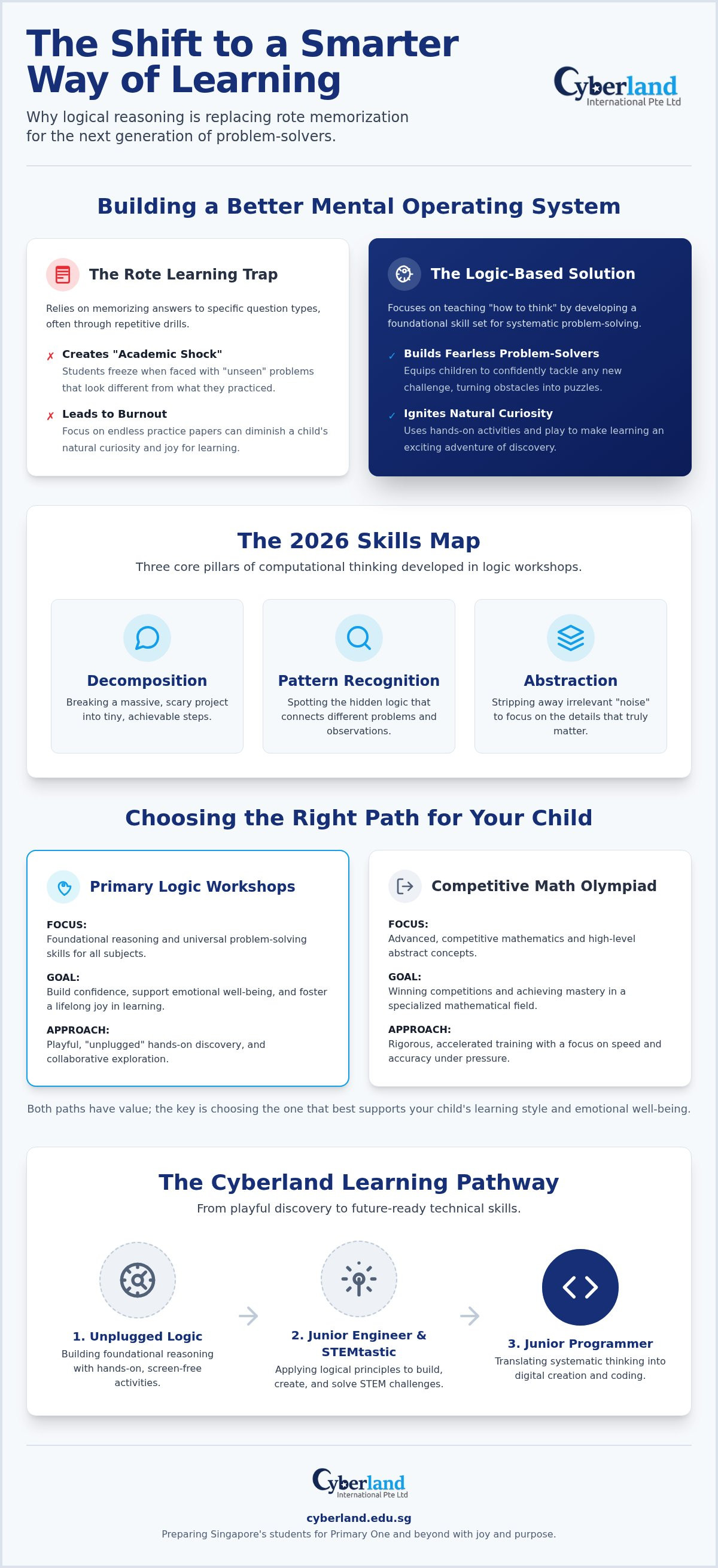
We call this building a "mental operating system." Just as a computer needs a strong OS to run complex apps, a child needs logic to handle 21st-century challenges. Understanding what critical thinking is helps us see that these skills aren't just for exams. They're for life. Early exposure is the best way to prevent "academic shock" when children transition to Primary One. By starting early, we ensure that the jump from preschool play to primary school rigor feels like a natural, exciting step rather than a daunting hurdle.
The Logic Gap in Traditional Primary Education
Traditional workbooks often focus on repetitive drills. They teach kids to recognize a specific question type rather than "how to think." This creates a gap. Parents often feel a deep sense of frustration when their child excels at homework but freezes during an "unseen" problem sum. It's heart-wrenching to see a bright child lose confidence just because the question looked a bit different. To bridge this, preparing preschoolers for Primary One logic is becoming a priority for proactive families. It's about moving from "memorizing the map" to "learning how to navigate" any terrain.
The 2026 Skills Map: What Primary Students Really Need
The modern curriculum demands more than just basic literacy. Students need a toolkit of cognitive strategies to thrive. In our primary school logic workshops, we focus on three pillars:
Decomposition: Breaking a massive, scary project into tiny, achievable steps.
Pattern Recognition: Spotting the hidden "logic" that connects a math problem to a science observation.
Abstraction: Stripping away the "noise" to focus on the details that actually matter.
These aren't just for STEM subjects. They help in English composition and even social interactions. We define computational thinking as a universal life skill used to solve problems efficiently through logic, sequence, and creativity. It's the ultimate tool for the next generation of innovators.
Inside the Workshop: How Children Learn to Think Systematically
Step into a room filled with the hum of focused excitement. Our primary school logic workshops don't start with a lecture. They start with a spark. Every session begins with a "hook," such as a mystery to solve or a physical challenge to overcome. This immediate engagement shifts the child's mindset from passive listening to active discovery. We believe that the best way to teach critical thinking is through doing. By placing the child at the center of the narrative, we turn every lesson into an adventure where they're the lead problem-solver.
One of our core philosophies is the "Unplugged" advantage. Before touching a screen, children engage with tactile materials. They use blocks, gears, and cards to map out their thoughts. This sensory experience is vital. It allows young learners to feel the weight of their decisions and see the physical results of their logic. This hands-on foundation is especially effective when parents focus on fostering curiosity in preschoolers before they even enter the classroom. When a child arrives with a "why" already on their lips, the workshop becomes a playground for their imagination.
Our mentors play a unique role in this process. They aren't traditional teachers; they're guides. Instead of providing the "right" answer, they offer a nudge or a strategic question. "What happens if we move this piece?" or "Is there another way to reach the goal?" This approach builds resilience. It teaches children that a mistake isn't a failure. It's just more data for their next attempt. You can see our philosophy in action by exploring the different learning pathways we offer for young minds.
Hands-On Discovery with Junior Engineer Modules
In our Junior Engineer sessions, logic takes a solid form. Children build physical models to visualize complex sequences. They experience the "click" of a locking brick and the "whir" of a spinning gear. These sounds and textures make abstract concepts concrete. The Junior Engineer program for kids serves as a vital precursor to more advanced logic. It's a nurturing environment where we celebrate every small win, building the confidence they'll need for future STEM challenges.
The STEMtastic Approach: Making Logic Visible
Our STEMtastic activities are designed to make thinking visible. Through collaborative puzzles, children must explain their reasoning to their peers. This social interaction is a powerful tool for logical development. They learn to listen, negotiate, and combine ideas to reach a shared goal. Whether it's balancing a complex structure or navigating a physical maze, these activities challenge their reasoning in real-time. It's vibrant, energetic, and deeply rewarding for every child involved. We focus on the joy of the process, ensuring that the logic they learn today becomes a skill they use forever.
Logic Workshops vs. Math Olympiad: Choosing the Right Path
Deciding on the best enrichment for your child often feels like standing at a crossroads. On one side, there's the prestige of Math Olympiad. On the other, the foundational growth found in primary school logic workshops. While both paths involve numbers and reasoning, their destinations are quite different. Math Olympiad is a sprint toward competitive medals and elite rankings. In contrast, logic workshops are a journey of discovery. They focus on building the "how" of thinking rather than just the "what."
The emotional impact of these choices matters deeply. High-pressure competitions can sometimes lead to anxiety or a fear of failure in younger students. We believe that learning should feel like an invitation, not a test. Logic workshops serve as a vital bridge for children who might find Olympiad-level math intimidating. They offer a gentle entry point into complex reasoning. This path allows them to build the stamina needed for longer problem-solving sessions. By prioritizing the joy of the process, we help children fall in love with problem-solving before they ever face a formal competition.
How do you choose? It often comes down to your child's personality. Is your child driven by competition and high-stakes challenges? Or do they thrive in environments where they can explore concepts at their own pace? For many families, the goal isn't just a trophy. It's a child who looks at a difficult problem and says, "I can figure this out."
When to Choose a Broad Logic Workshop
If your child needs a confidence boost, a broad logic workshop is the perfect starting point. These sessions are designed to spark a genuine interest in STEM through play. We use sensory-focused activities to make abstract ideas feel real. This approach is particularly effective for critical thinking for early learners. Our educators act as nurturing guides, ensuring every child feels heard and supported. We focus on the "aha!" moments that build a lasting sense of self-assurance.
The Synergy: How Logic Supports Competitive Math
Choosing logic doesn't mean you're abandoning competitive success. In fact, it provides the reasoning backbone needed for the most difficult Olympiad questions. Without a strong logical foundation, children often struggle when a math problem deviates from the standard formula. Logic is the foundation upon which all competitive subjects are built. Once this base is secure, moving into a junior programmer course Singapore becomes a natural and exciting next step. This synergy ensures that your child isn't just memorizing tricks, but truly understanding the mechanics of the world around them.
Key Skills Developed in Primary School Logic Workshops
Logic is more than a buzzword. It's a set of concrete tools that change how a child interacts with the world. In our primary school logic workshops, young learners acquire four core skills that redefine their approach to any challenge. These aren't just abstract academic concepts. They're practical strategies used by engineers, designers, and innovators every day. By mastering these early, children gain a massive head start in their cognitive development.
It starts with Decomposition. Large, complex problems can feel overwhelming to a young learner. We teach them to slice these challenges into manageable, bite-sized tasks. This makes the "impossible" feel achievable. Next is Pattern Recognition. By spotting similarities between a new puzzle and one they've solved before, children learn to apply known solutions to new situations. It's the ultimate shortcut for efficient learning and reasoning.
We also focus on Abstraction, which is the art of clarity. It's the ability to strip away distracting details and focus only on the core mechanics of a solution. Finally, Algorithmic Thinking allows children to create clear, step-by-step instructions. Whether they're building a physical model in our Junior Engineer module or planning a sequence of events, they learn the value of a logical, predictable flow. These skills form the "mental operating system" that will power their future success.
From Logic to Coding: The Junior Programmer Path
Logical thinking is the silent engine behind every great piece of software. It directly translates into successful coding because logic provides the "thought" while code provides the "language." Once a child masters these foundational skills, the transition to a junior programmer course Singapore feels effortless and natural. They aren't just memorizing syntax or commands. They're expressing a structured plan they've already visualized. This bridge from physical logic to digital creation is where true innovation begins.
Social and Emotional Logic
Logic isn't just for STEM subjects. It's for the heart too. Our workshops create a safe, nurturing space for children to handle failure with grace. When a model doesn't work or a sequence fails, we teach them to "debug" their own mistakes. This process builds incredible resilience and self-assurance. Through collaborative STEM challenges, they learn that a setback is just a puzzle waiting for a solution. As your supportive partner, we nurture this growth so your child feels empowered to try, fail, and try again. Ready to see your child transform into a confident problem-solver? Explore our Junior Engineer and STEMtastic workshops today.
Cyberland's Approach to Logic: Building Future-Ready Minds in Singapore
Discovery isn't just a goal for us. It's our daily practice. Cyberland is more than an enrichment center. We're a supportive partner for families across Singapore. Our central location in Ang Mo Kio Industrial Park 2 makes it easy for parents to prioritize their child's cognitive growth. We've built an environment that feels like a laboratory of wonder. Here, every child is an innovator. Every question is a doorway. We believe that when you change how a child thinks, you change their entire world. Our primary school logic workshops are the catalyst for that transformation.
We're committed to the joy of discovery. It's about more than just checking off a curriculum. It's about the "aha!" moment when a complex puzzle finally clicks. We want our students to feel the thrill of solving something "unseen." This confidence carries over into their schoolwork and their lives. By focusing on the trajectory of a child's development, we ensure they're ready for the challenges of 2026 and beyond. You're invited to see this energy in action and join a community that celebrates curiosity.
Partnering with Schools for STEMtastic Results
We extend our reach through a robust partnership model. We collaborate with local preschools and primary schools to deliver our primary school logic workshops through the STEMtastic module. This brings professional educational authority directly into the school environment. Administrators trust us to provide high-quality enrichment that aligns with modern educational goals. We don't just deliver content. We ignite interest. We want students to leave our sessions feeling empowered. By partnering with schools, we ensure that high-level logic training is accessible to as many young learners as possible.
Getting Started: Your Child’s Logic Journey
Ready to begin this exciting adventure? The path to building a future-ready mind is simple and supportive. We offer a variety of modules tailored to different developmental stages. You can start with the tactile discovery of our Junior Engineer program or move into the logic-heavy Junior Programmer modules. Each step is designed to build on the last, creating a seamless flow of learning. Here is how you can get started:
Explore our modules: Visit our website to see the full range of Nursery, Kindergarten, and Primary enrichment options.
Inquire for enrollment: Contact our Ang Mo Kio hub to find a schedule that fits your family's needs.
School partnerships: Administrators can reach out to discuss bringing our workshops to their campus.
We're here to guide you through every step. Your child’s logic journey is a trajectory of growth. We can't wait to see them shine and discover their own potential. Believe in their ability to solve the impossible. The future is bright, and it starts with a single logical step at Cyberland.
Empowering the Next Generation of Thinkers
Preparing your child for the future means giving them the tools to navigate a world of "unseen" challenges. We've explored how primary school logic workshops move beyond rote learning to build a robust mental operating system. By focusing on hands-on discovery and systematic thinking, young learners transform from passive students into fearless problem-solvers. Whether they're exploring our specialized Junior Engineer modules or advancing into Junior Programmer modules, children learn that every mistake is just a step toward a solution.
Cyberland brings over a decade of experience in Singapore STEM enrichment to every session. As a trusted partner of numerous local preschools and primary schools, we're dedicated to igniting a lifelong passion for growth. It's time to replace academic burnout with the joy of discovery. We're here to support your family's journey toward confidence and technical mastery.
Ignite your child’s curiosity with Cyberland’s Primary School Logic Workshops today!
Your child has limitless potential. Let's unlock it together through the power of logic, wonder, and purposeful play. We can't wait to see what they'll discover next.
Frequently Asked Questions
What is the best age for a child to start a logic workshop?
Children can start as early as age 4 in our Nursery and Kindergarten enrichment modules. Early exposure helps build neural pathways for reasoning before academic pressure increases. While kids aged 7 to 12 benefit immensely from advanced modules, starting young fosters a natural "Maker Mindset." This early start ensures that logical thinking becomes a second language rather than a forced skill later in their primary school journey.
How is a logic workshop different from regular math tuition?
Traditional math tuition often focuses on memorizing formulas to pass specific exams. In contrast, primary school logic workshops focus on the underlying reasoning process. We teach children how to deconstruct any problem, regardless of the subject. Instead of drill-and-practice, we use hands-on discovery. This builds a versatile "mental operating system" that helps students tackle "unseen" questions that standard tuition often fails to address.
Does my child need prior coding experience to join a logic workshop?
No prior experience is necessary to join any of our modules. We design our curriculum to meet every child at their current level. Beginners often start with our Junior Engineer or STEMtastic modules to build physical reasoning skills. These workshops provide the perfect foundation for digital creation. We guide students from basic logical sequences to more complex tasks, ensuring they feel confident and supported at every stage of their learning journey.
How do logic workshops help with Primary One preparation in Singapore?
Logic workshops bridge the gap between preschool play and the more rigorous Primary One curriculum. By developing skills like pattern recognition and decomposition early, children avoid the "academic shock" of new subjects. They learn to follow multi-step instructions and approach word problems with a calm, systematic mindset. This preparation ensures they enter the primary school environment as confident learners ready to engage with complex concepts from day one.
Can logic workshops help a child who is struggling with school-level problem sums?
Yes, we specifically target the "mental block" children face with non-routine problem sums. Many students struggle because they don't know where to begin. Our workshops teach them to strip away unnecessary details and identify the core logic of a question. By practicing these strategies in a low-pressure, hands-on environment, children build the resilience needed to tackle difficult school assignments with a clear, organized strategy.
What are "unplugged" logic activities and why are they important?
"Unplugged" activities are logic-based tasks performed without any digital screens. These include using physical blocks, gears, or card games to solve puzzles. They're important because they reduce screen fatigue while emphasizing tactile learning. By physically manipulating objects, children gain a deeper, sensory understanding of logical sequences. This hands-on foundation is a critical precursor to our Junior Programmer modules, where they eventually translate these physical concepts into digital code.
Are these workshops conducted in schools or at your centre in Ang Mo Kio?
We offer both options to ensure accessibility for all families. Our main hub is located in Ang Mo Kio Industrial Park 2, providing a dedicated space for discovery. Additionally, we partner with numerous preschools and primary schools across Singapore to deliver our workshops directly on campus. This partnership model allows school administrators to integrate high-quality STEM enrichment into their existing schedules, making it easier for students to access these vital skills.
How do I know if my child is progressing in their logical thinking skills?
You'll see progress through your child's increased confidence and problem-solving speed. In our primary school logic workshops, mentors provide regular feedback on how a child handles new challenges. Look for small wins, such as your child attempting a difficult puzzle without asking for immediate help. Over time, their ability to explain their reasoning and "debug" their own mistakes becomes a clear indicator of their growing logical maturity and resilience.


Comments