
Primary School Robotics: 2026 Singapore Guide

What if your child's favorite afternoon activity was actually the secret to their 2026 Direct School Admission success? It's a natural concern for many parents. You might worry about excessive screen time or wonder if robotics is just "expensive play" without real results. You're likely searching for a primary school robotics curriculum Singapore educators trust to align with MOE's Applied Learning Programmes. We know you want more than just a distraction. You want a clear, structured path to future readiness and academic growth.
This guide explores the essential components of a curriculum that prepares students for a tech-driven world. You'll gain a clear understanding of learning milestones and the 2026 DSA-Sec timeline, where applications open as early as May. We'll also look at how "AI for Fun" modules and competitions like the National Robotics Competition transform simple building into sophisticated problem-solving. Discover how programs like STEMtastic can nurture your child's curiosity and turn them into a confident, visionary innovator. Let's bridge the gap between digital ideas and real-world engineering together.
Table of Contents
Navigating the Primary School Robotics Curriculum in Singapore (2026)
A robotics curriculum is more than just playing with toys. It's a structured sequence of learning. It combines mechanical engineering, coding, and logical reasoning into a single, cohesive experience. As Singapore marches toward its 2026 Smart Nation goals, the primary school robotics curriculum Singapore provides has become a cornerstone of future-readiness. It's about building a foundation of digital literacy that starts early. We want our children to be creators, not just consumers.
Primary school is the "golden window" for this growth. Between the ages of 7 and 12, children are naturally curious. Their brains are like sponges. By introducing Educational robotics during these years, we spark a lifelong passion for STEM. External enrichment providers play a vital role here. They support school-based Applied Learning Programmes (ALP) by providing specialized tools and expertise. This partnership ensures every student has access to high-quality, interactive tech education.
The Evolution of STEM Education in Local Schools
STEM education has come a long way. We've moved past basic block-building. Today, the focus is on complex computational thinking. The 2026 curriculum focuses on real-world problem solving. Students don't just build a car; they build a vehicle designed to solve a specific challenge, like navigating a simulated disaster zone. This shift ensures that tech education is inclusive. It reaches every student, regardless of their starting point, and prepares them for a rapidly changing world. It's about turning big ideas into tangible solutions.
Why Hands-on Learning Outperforms Screen-Only Coding
Screens are everywhere, but they aren't everything. Physical robot assembly offers unique tactile benefits. It strengthens fine motor skills as children manipulate small gears and sensors. More importantly, it bridges the gap between abstract code and physical movement. When a child sees their code make a physical motor spin, the "aha!" moment is powerful. Tactile robotics is the integration of physical hardware with logical software commands. It makes learning visible and exciting.
Through programs like STEMtastic, students move from being passive observers to active innovators. They start with Junior Engineer modules to understand mechanics. Then, they progress to Junior Programmer courses to master the logic. This hands-on approach ensures that learning isn't just "expensive play." It's a meaningful, rhythmic cycle of discovery and growth. Every gear turned and every line of code written builds confidence for the future.
Core Pillars of an Effective Robotics Program for Young Learners
Building a world-class primary school robotics curriculum Singapore students love requires a balance of four essential pillars. It isn't enough to just give a child a tablet and some plastic blocks. Real growth happens when we integrate mechanical literacy with deep logical reasoning. This holistic approach ensures that students don't just follow instructions; they understand the "why" behind every movement.
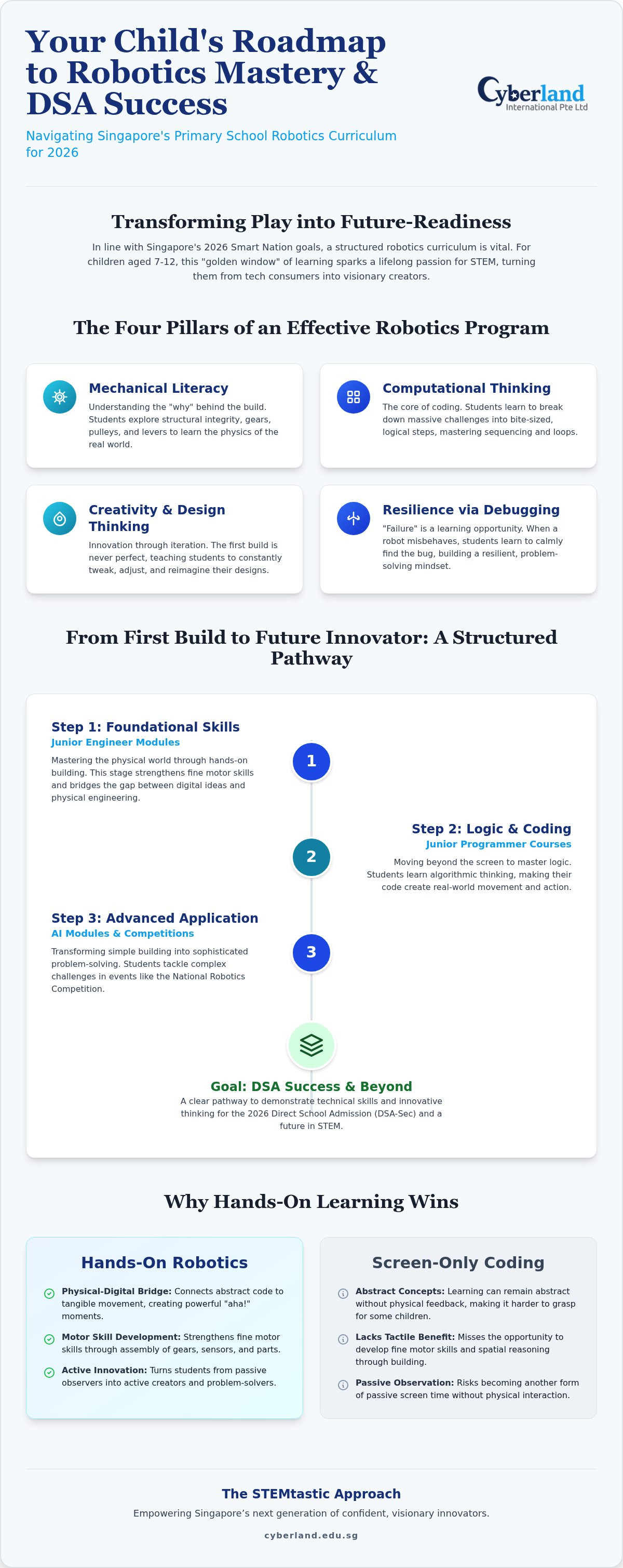
Mechanical Literacy: Kids need to understand structural integrity. Why does a tall tower fall? How do gears transfer power? By exploring pulleys and levers, they learn the physics of the real world.
Computational Thinking: This is the heart of the Code for Fun programme. It teaches students to break down massive challenges into bite-sized, logical steps.
Creativity and Design Thinking: We encourage students to iterate. Their first build won't be perfect. That's the point. They learn to tweak, adjust, and reimagine their designs.
Resilience through Debugging: In engineering, "failure" is just a fancy word for a learning opportunity. When a robot doesn't move as expected, students learn to stay calm and find the bug. It builds a mindset that lasts a lifetime.
The Junior Programmer Logic: Beyond the Screen
Introducing algorithmic thinking doesn't have to be overwhelming. We focus on sequencing and loops through interactive play. Our junior programmer course Singapore families trust sets the stage for Primary 1 logic. It's about teaching the brain to think in patterns. This foundation ensures that when they encounter more complex code later, they already have the mental map to succeed. We make logic feel like a game.
Engineering Fundamentals in the Junior Engineer Journey
Every child asks, "how does it work?" We turn that question into a discovery mission. By exploring simple machines, students see how robotics applies to modern life. The junior engineer program for kids links these basic concepts to real-world applications. It's a journey of discovery that transforms a curious child into a confident young builder. This hands-on experience is a vital part of a comprehensive primary school robotics curriculum Singapore parents value for long-term development.
If you are ready to see your child's curiosity ignite, explore our STEMtastic workshops designed specifically for local school environments. We believe every child has the potential to be a visionary innovator.
Evaluating Robotics Workshops: What Schools and Parents Must Look For
Choosing the right partner for your child's technical journey is a big decision. You want more than a flashy kit or a one-off experience. You want a program that grows with your student. A high-quality primary school robotics curriculum Singapore providers offer must demonstrate clear depth. Does the learning stop at building a basic model? Or does it challenge them to think like visionary engineers? Progression is the key to lasting impact.
Look closely at the people in the room. Instructors should be mentors, not just supervisors. They must be trained to handle primary-aged children with a nurturing tone that encourages questions. They should spark wonder in every session. Engagement is the ultimate test of any workshop. If a child is just watching a screen, they aren't learning robotics. They need to be hands-on. They need to be testing theories and making their own discoveries. Active participation is where the magic happens.
Alignment with national standards provides vital peace of mind for parents and educators alike. Ensure the program supports STEM enrichment programs Singapore schools value. This ensures the skills learned in the workshop reinforce what's taught in the classroom. It creates a cohesive learning experience that bridges the gap between school syllabus and real-world application.
School Partnerships and STEMtastic Workshops
For educators, vendor reliability is everything. You need a partner that understands the unique rhythm of the school environment. Our STEMtastic workshops provide a turnkey solution for busy teachers. We handle the logistics so you can focus on the students. We also believe in flexibility. We can customize our curriculum to fit your school's specific Applied Learning Programme (ALP) goals. It's a collaborative approach to excellence.
Safety and Equipment Quality
Safety is never an afterthought in our workshops. All hardware must be age-appropriate and robust. We use industrial-grade building components that can withstand the enthusiasm of young learners. It's quality you can feel. Proper guidance is also essential for a positive experience. Maintaining a high student-to-teacher ratio ensures every child gets the attention they deserve. They stay safe, feel heard, and remain inspired throughout their journey.
From Classroom to Competition: Pathways for DSA and Beyond
The journey from a curious beginner to a confident secondary school applicant is a series of small, exciting steps. It starts with a spark. A world-class primary school robotics curriculum Singapore parents trust should provide a clear roadmap for this growth. We don't just teach kids to build; we guide them through a developmental pathway that turns interest into expertise. This structured progression ensures every child finds their rhythm.
Step 1: Sparking Interest. Our Junior Engineer modules introduce the basics of mechanics. It's about the joy of making things move and understanding how gears click together.
Step 2: Developing Proficiency. Students move to Junior Programmer courses. Here, they master the logic that brings their physical creations to life through code.
Step 3: Local Showcases. Participating in school-level showcases builds confidence. It's a chance to share discoveries with peers and teachers in a supportive environment.
Step 4: Building a DSA Portfolio. For those looking toward the 2026 Direct School Admission (DSA-Sec) exercise, a strong portfolio is essential. With applications typically opening in early May, success in robotics demonstrates the commitment and technical talent schools seek.
Step 5: Advanced Languages. In later primary years, we introduce advanced concepts like Python. This prepares them for the rigors of secondary school STEM and beyond.
Preparing for Primary One Logic and Reasoning
Robotics provides a vital head start for the cognitive demands of Primary One. It isn't just about tech. It's about mental agility. By focusing on critical thinking for early learners, we help children build academic confidence before they even step into a formal classroom. Robotics serves as a powerful tool for mathematical and spatial visualization. When a child calculates a turn or visualizes a 3D structure, they're practicing core academic skills through play. It makes complex concepts feel natural and approachable from day one.
The Role of Competitions in Personal Growth
Competitions are about more than winning trophies. They're about people. Group robotics projects foster teamwork and communication. Students learn to listen, negotiate, and lead. Handling the pressure of a live event like the National Robotics Competition requires an optimistic and resilient mindset. We teach them that every challenge is a chance to grow. Through our STEMtastic project model, students showcase true innovation. They learn to present their ideas with pride and clarity. This holistic development is what makes a primary school robotics curriculum Singapore educators recommend so effective for long-term success.
Ready to give your child a competitive edge and a lifelong love for learning? Start your child's robotics journey today and watch them transform into a visionary innovator.
Cyberland’s STEMtastic Approach: Empowering Singapore’s Next Generation
At Cyberland, we believe every child is a natural-born explorer. Our mission is simple. We nurture the curiosity and creativity that already exists within every student. By providing a primary school robotics curriculum Singapore educators trust, we turn the classroom into a laboratory of wonder. We're more than just a training center. We're an inspiring mentor and a reliable guide for the next generation of thinkers. We focus on the joy of discovery and the positive trajectory of every child's unique development.
What sets us apart? It's the Cyberland difference. We strike a perfect balance between professional educational authority and a warm, inviting atmosphere. Our team deeply understands child psychology and developmental milestones. We know how to turn a complex engineering challenge into a playful, accessible adventure. We invite you to see this magic for yourself. Join us at Ang Mo Kio Industrial Park 2 to see our programs in action. It's a space where big ideas come to life and where the "kampung spirit" of collaboration thrives.
Junior Engineer and Junior Programmer: A Dual Path
We don't believe in a one-size-fits-all approach. Instead, we tailor our modules to the specific developmental milestones of 4 to 12-year-olds. This ensures the challenge is always just right for their growing minds. In our Junior Engineer sessions, students explore the physical world of gears, pulleys, and structures. As they gain confidence, they transition into more complex logic. The Junior Programmer course serves as a gateway to digital literacy through playful discovery. Every child leaves our sessions feeling like a "bold innovator." They gain both the technical skills and the emotional confidence to lead in a tech-driven world.
Partnering with Cyberland for School Enrichment
We're proud to be the preferred choice for local educators across the island. Our robotics workshops for primary schools Singapore schools love are built on the foundation of partnership. We don't just deliver a program; we co-create engaging STEM environments. Our team works closely with teachers to align our STEMtastic curriculum with specific Applied Learning Programme (ALP) goals. This ensures every workshop reinforces the school's unique educational vision.
The impact is clear. Our workshops boost student motivation and transform school culture into one of innovation and resilience. We ignite a passion for discovery that lasts long after the final robot is packed away. It's about building a community of learners who aren't afraid to dream big. Ready to ignite interest? Contact Cyberland to bring STEMtastic workshops to your school! Together, we can empower Singapore's next generation of visionary leaders and creators.
Ignite Your Child's Visionary Potential Today
The journey into robotics is a transformative experience for every young learner. It turns natural curiosity into concrete technical skills. We've explored how a world-class primary school robotics curriculum Singapore families trust provides the perfect bridge between play and academic excellence. By mastering mechanical literacy and logical reasoning, your child develops the resilience needed for the 2026 Direct School Admission exercise and beyond. Every gear turned is a step toward a brighter future.
At Cyberland, we're your supportive partner in this exciting growth journey. Our expertly designed Junior Engineer and Junior Programmer modules are crafted to spark wonder and technical proficiency. With nurturing instructors focused on child development, we're a trusted partner for Singapore primary schools across the island. We invite you to join our community of bold innovators and creators. Empower your child's future with Cyberland's STEMtastic workshops! The path to discovery starts with a single click. We can't wait to see what your child will build next.
Frequently Asked Questions
What is the best age to start a robotics curriculum in Singapore?
The best time to start is between the ages of 4 and 12 years old. Cyberland offers specialized Nursery and Kindergarten enrichment to ignite early curiosity and spatial awareness. Starting early helps children view technology as a creative tool rather than just a screen for consumption. Our primary school robotics curriculum Singapore programs scale with your child's developmental milestones. This ensures they stay inspired while building a lifelong foundation in STEM.
How does a robotics curriculum help with Direct School Admission (DSA)?
Robotics helps by building a robust technical portfolio that showcases talent. The 2026 DSA-Sec exercise rewards students who demonstrate proficiency in STEM through competitions like the National Robotics Competition. Participation in these events provides concrete evidence of leadership and logical reasoning. This technical expertise, combined with a bold innovator mindset, makes your child stand out to prestigious secondary schools during interviews. It's about proving commitment to a specialized craft.
Is coding mandatory in the 2026 primary school robotics syllabus?
Coding is now a standard part of the upper primary experience. The Code for Fun programme, a joint MOE and IMDA initiative, provides a mandatory 10-hour curriculum for students. In 2025, AI for Fun modules were added to further enhance digital literacy across schools. Our workshops complement this national effort by providing deeper, hands-on engagement. We ensure students move beyond basic screen-time to master true computational thinking and real-world application.
Can robotics workshops help with my child's mathematics and science grades?
Robotics turns abstract classroom concepts into physical reality. When students calculate gear ratios or angles for a robot's turn, they're applying Primary Mathematics in real-time. Science concepts like friction, forces, and energy transfer become tangible during assembly. This hands-on application reinforces school learning and builds academic confidence. It's a rhythmic cycle where theory meets practice. Your child finally sees the "why" behind the numbers and formulas on their page.
What is the difference between Cyberland's Junior Engineer and Junior Programmer modules?
Junior Engineer focuses on the mechanics of physical machines. Students explore gears, pulleys, and structural integrity to understand engineering fundamentals. Junior Programmer dives into the logic of sequences. It focuses on algorithmic thinking and coding to bring those machines to life. Together, they offer a dual path of discovery. This comprehensive approach ensures a well-rounded foundation in both the hardware and software of modern technology for every young learner.
How do Cyberland's robotics workshops align with MOE's Applied Learning Programmes (ALP)?
We act as a trusted partner for local schools. Our primary school robotics curriculum Singapore workshops are designed as turnkey solutions that integrate with school-wide goals. We customize our STEMtastic modules to fit specific school themes, whether they focus on sustainability or smart city innovation. This helps educators meet MOE's Applied Learning Programme standards without the logistical burden. We bring the expertise and industrial-grade equipment directly to your school environment.
Do children need prior coding experience to join primary school robotics?
No prior experience is needed to begin the journey. Our programs are designed to meet every child at their current level. We use a friendly guide approach to introduce basic logic and mechanics through playful discovery. Beginners start with simple building tasks that spark immediate success and joy. As their confidence grows, we introduce more complex technical challenges. Every child has the potential to become a visionary innovator with the right nurturing.
What equipment is typically used in a primary school robotics curriculum?
We use high-quality, industrial-grade components for every session. Students work with specialized gears, motors, and sensors to build robust physical models. Tablets or laptops run intuitive coding software that bridges the gap between hardware and software commands. Safety is our priority, so all materials are age-appropriate and safe for primary learners. This professional-grade equipment ensures the building experience is both satisfying and technically accurate for every young engineer in our workshops.


Comments