
Sparking Curiosity: Why Hands-on Learning for Children is the Key to Future Success

Updated: Aug 9
What if the secret to Primary 1 success isn't found in a thicker stack of assessment books? Many Singaporean parents worry that rote memorization leads to burnout rather than real understanding. You want your child to be future-ready. You want them to stay curious and excited. This is why hands-on learning for children is becoming the gold standard for early development. It moves beyond the desk and into the world of active, sensory discovery. It's about making education feel alive.
We know you're looking for that perfect balance between fun and academic rigor. It's a common goal to build technical logic and creative confidence as we head into 2026. This article explores how "learning by doing" creates deep memory retention and a genuine passion for STEM subjects. We'll show you how to turn anxiety about school readiness into a journey of joyful, purposeful growth. Discover how simple, interactive experiences can prepare your child for a rapidly changing world.
Table of Contents
What is Hands-on Learning for Children? (And Why It’s Not Just Play)
Hands-on learning for children isn't just a break from "real" study. It is a deliberate shift from passive absorption to active inquiry. Instead of sitting still and listening to a lecture, children engage their senses to solve problems. This method, often called Learning-by-doing, ensures that students aren't just spectators in their own education. They become the architects of their own understanding. It's a process where curiosity leads to action, and action leads to deep, lasting knowledge.
Think of it as a tactile-to-digital bridge. When a child manipulates physical blocks in our Junior Engineer sessions, they are learning the foundations of structural logic. These same logical patterns later become the building blocks of code in our Junior Programmer modules. This "play with purpose" is actually more demanding than simple memorization. It requires focus, spatial awareness, and the ability to connect abstract concepts to the real world. This process builds what we call creative confidence. It is the inner belief that they can tackle any challenge, no matter how complex it seems at first.
Tactile Learning vs. Passive Observation
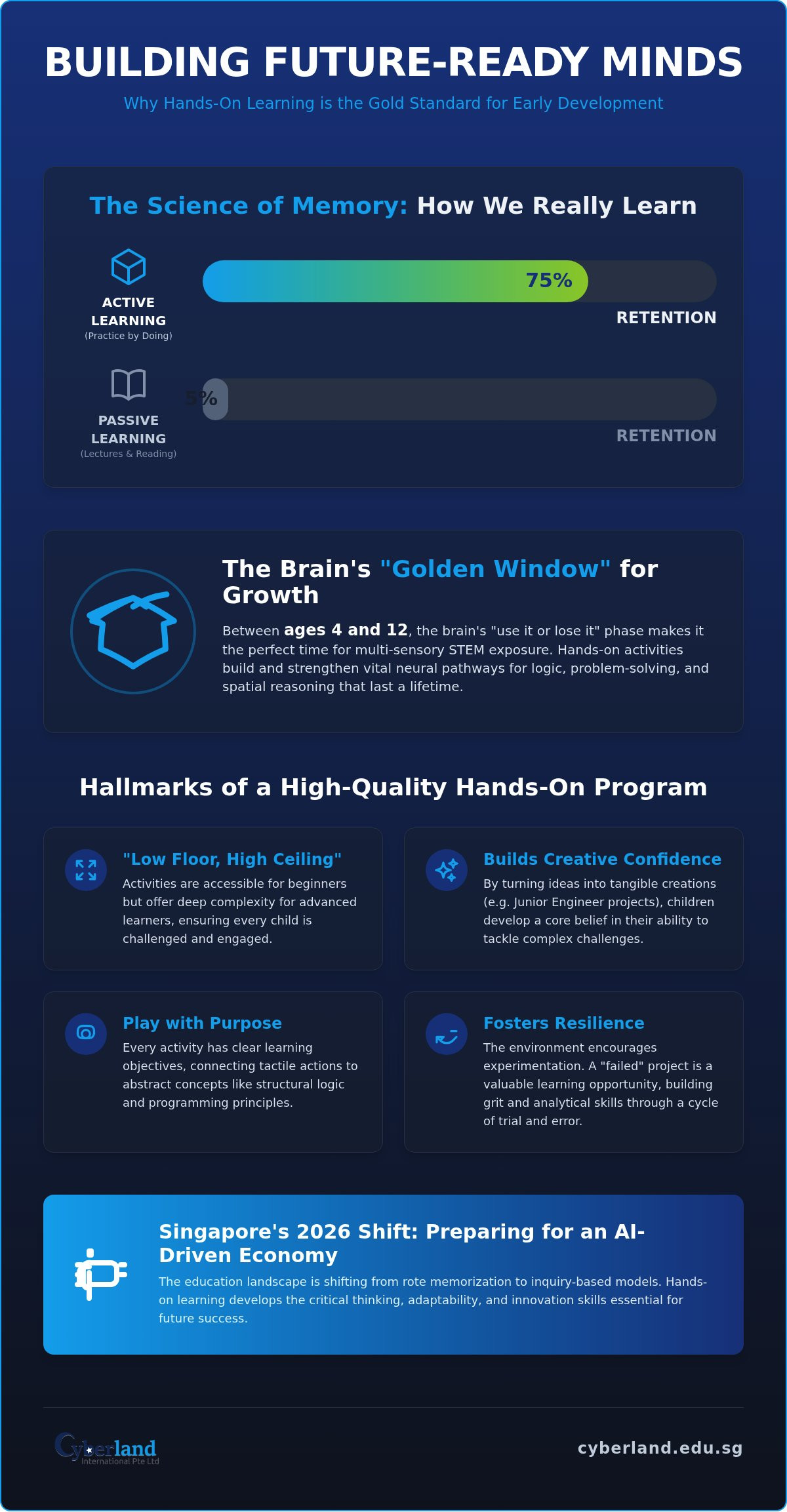
There is a massive difference between watching a video about gravity and building a marble run. When children build, they feel the weight and see the speed. Educational research, specifically the Learning Pyramid model, suggests that children retain up to 75% of information when they practice by doing. Compare this to the mere 5% to 10% retention rate associated with passive listening or reading.
This constant cycle of trial and error is exactly how resilience is born. It's not about getting it right the first time. It's about having the grit to find out why it went wrong. This same dedication to growth through challenge is found in physical wellness, where Stoic Strength provides customized fitness coaching to help individuals build lasting resilience.
The Myth of the 'Messy' Classroom
Some parents worry that a hands-on environment is just chaotic play. In reality, structured hands-on learning for children follows a rigorous scientific method. Every activity has a specific goal. In our STEMtastic workshops, we balance the freedom to explore with clear learning objectives. We define experiential learning as a curated environment for discovery. It is an organized space where every tool and task is designed to trigger a specific "aha!" moment. It's not just about the mess on the table; it's about the neural pathways being formed in the mind. By 2026, this ability to think critically and adapt will be far more valuable than the ability to recite facts from a textbook.
The Science of Discovery: How Hands-on STEM Rewires the Brain
Learning isn't just about absorbing facts. It's about building physical structures in the brain. When kids engage in hands-on learning for children, they aren't just memorizing; they're creating a dense web of neural connections. Each time a child touches a wire or snaps a gear into place, multiple senses fire at once. This multi-sensory engagement makes the brain work harder and smarter. It builds a foundation that traditional textbooks simply can't match. It's the difference between hearing about a spark and feeling the friction that creates it.
Between the ages of 4 and 12, the brain undergoes a process called synaptic pruning. This is the "use it or lose it" phase, making it the golden window for development. During this time, the brain keeps the connections that are used frequently and discards those that aren't. Early exposure to engineering and logic ensures these vital pathways stay strong. By introducing these concepts early, we help children develop a natural intuition for how things work. This reduces the cognitive load later in life, as complex ideas already feel familiar and manageable.
Engaging Multiple Learning Styles Simultaneously
Every child learns differently. Some need to see a diagram, while others need to hear an explanation. Hands-on activities are unique because they cater to visual, auditory, and kinesthetic learners all at once. When a child builds a robot, they see the design, hear the motor, and feel the friction of the parts. This creates the "Aha!" moment, a rush of neurochemistry that rewards successful problem-solving. This is how we build the Junior Engineer mindset, developing spatial reasoning that lasts a lifetime.
From Concrete to Abstract Thinking
Developmental psychologists like Piaget noted that children need to interact with the physical world to understand abstract ideas. A 4-year-old needs to touch a physical gear and feel its resistance before they can understand the logic of coding a motor. Tactile feedback speeds up abstract concept mastery by providing immediate, physical proof of logical theories. This bridge is essential for moving from simple play to complex technical logic. It ensures that hands-on learning for children remains both grounded and intellectually stimulating.
Global leaders emphasize the importance of STEM education for developing critical thinking skills early in life. By bridging the gap between physical play and technical logic, we prepare children for the challenges of 2026 and beyond. If you're ready to see your child's confidence soar, consider enrolling them in our STEMtastic workshops where we turn science into a hands-on adventure.
Beyond Rote Memorization: The Singapore Context in 2026
In an AI-driven economy, being a "human calculator" is no longer enough. Computers handle the calculations; we need children who can handle the creativity. We want our kids to be the ones designing the systems, not just following instructions. This requires a deep foundation in critical thinking and collaboration. These soft skills are best developed when children work together to solve a physical problem. It turns a classroom into a laboratory for future leaders.
Rote Learning vs. Hands-on Inquiry
Traditional models often lead to a "forget after the exam" cycle. When a child only memorizes a formula, they don't own the knowledge. It's just borrowed information. In contrast, a curiosity-first approach ensures the knowledge sticks. Here is how the two methods compare in a practical setting:
Preparing for the Future Economy
Singaporean employers are increasingly looking for problem solvers over simple test-takers. They value the grit it takes to fix a broken model. This is where Cyberland’s Junior Programmer course makes a difference. It doesn't just teach code; it teaches the logic behind the code. By building physical projects first, preschoolers gain the spatial reasoning needed for Primary 1. It bridges the gap between nursery play and formal education. You can learn more about this transition in our guide on preparing preschoolers for Primary One logic and reasoning. We help your child enter the next stage of their education with a genuine love for discovery.
4 Signs of a High-Quality Hands-on Program for Kids
Choosing the right environment for hands-on learning for children is a critical decision for parents. It isn't just about the equipment in the room. It's about the philosophy behind the tools. A high-quality program should feel like a guided adventure. It should offer "low floor, high ceiling" activities. This means a child can start building immediately with no prior knowledge, yet the complexity can scale as their skills grow. It keeps them challenged without feeling overwhelmed. It turns frustration into focus.
How do you spot a program that actually delivers? Look for these four essential markers:
Structured Curriculum: There should be a clear path from "what is this?" to "look what I made!" Random play is fun, but purposeful exploration is where the real growth happens.
Quality Materials: The tools should be age-appropriate and professional. Whether it's tactile blocks for Kindergarten Enrichment or advanced robotics, the gear must be safe and inspiring.
Supportive Mentorship: Instructors should act as guides, not lecturers. They should facilitate discovery rather than just handing out answers.
Visible Outcomes: Every session should result in a tangible project. This builds the "creative confidence" we discussed earlier.
Curriculum Depth and Progression
A great program offers a journey, not just a one-off workshop. It should support a child's development from Nursery all the way to Primary 6. This long-term approach ensures that concepts aren't just visited; they are mastered. For example, our Junior Engineer modules are designed to build on previous lessons. A child might start by understanding simple gears and eventually move toward complex mechanical systems. This progression creates a solid foundation of technical logic. It ensures that the "Aha!" moments keep coming as they grow older.
The Role of the Educator
The instructor's role is the heart of the experience. The best mentors are those who ask the right questions. They don't just fix a broken model for a child. They ask, "Why do you think it isn't moving?" This encourages the child to analyze and troubleshoot. Small group ratios are essential for this type of personalized guidance. It allows the mentor to act as a partner in discovery. If you are an educator or school leader, you can explore our STEM Programs for Schools Singapore: 2026 Curriculum to see how we integrate these principles into local classrooms.
Ready to see your child's curiosity ignite? We invite you to explore our upcoming workshops and find the perfect fit for your little innovator.
Sparking Innovation with Cyberland’s STEMtastic Workshops
Cyberland isn't just an enrichment provider. We are a bridge to the future. Our unique approach to hands-on learning for children turns abstract concepts into physical reality. In our workshops, theory isn't something you simply read about in a book. It's something you build, touch, and test. We believe every child is a natural innovator. They just need the right environment to let that creativity flourish. By 2026, the ability to solve problems with both technical logic and creative flair will be the ultimate competitive advantage.
Our curriculum is designed to grow with your child. From the tactile foundations of our Junior Engineer modules to the logical complexities of the Junior Programmer path, we ensure a seamless transition. We take the fear out of STEM. Instead of daunting equations, we offer exciting challenges. This shift in perspective is what makes our workshops a favorite among Singaporean families and educators alike. We don't just teach science; we ignite a lifelong passion for discovery.
The Junior Engineer Journey
Every session begins with a spark. We present a problem statement that triggers immediate curiosity. For example, "How can we lift this heavy load using only gears?" From there, children move straight into a physical build. They use age-appropriate engineering tools specifically designed for the 4 to 12 age group. You'll hear the satisfying click of blocks and the quiet whir of motors as they bring their ideas to life. It's a vibrant, sensory experience that keeps them fully engaged from start to finish.
Build. Test. Refine. This is the rhythm of our classroom. We've cultivated an uplifting atmosphere where every mistake is viewed as a valuable learning opportunity. If a bridge collapses or a gear slips, we don't call it a failure. We call it a puzzle. This mindset helps children develop the grit and resilience they'll need for Primary 1 and beyond. They learn that innovation is a process, not a one-time event. This builds a level of creative confidence that stays with them long after the workshop ends.
STEMtastic: Bringing Workshops to Your School
We don't just wait for you to come to us. Cyberland partners with local Singapore preschools and primary schools to deliver high-quality workshops on-site. Our STEMtastic modules are designed to fit seamlessly into the school day. This partnership allows us to support the MOE's "Joy of Learning" initiatives directly within the school environment. It's the ultimate convenience for busy parents. Your child receives professional-grade enrichment without the need for extra travel.
We invite you to visit our main center at Ang Mo Kio Industrial Park 2. Come see the sparks of innovation in action. Whether your child is just starting their journey in Kindergarten Enrichment or is ready for the technical logic of our Junior Programmer course, we have a path for them. Let's work together to build a bright, tech-savvy future for the next generation. Our doors are always open to parents who want to see how "learning by doing" changes lives.
Discover how Cyberland can bring hands-on STEM to your school and start your child's journey toward future success today.
Build Your Child's Future with Creative Confidence
The journey from curiosity to mastery starts with a single physical build. We've seen how active inquiry transforms abstract logic into tangible skills. It prepares young minds for the rigor of Primary 1 while keeping the spark of discovery alive. By choosing hands-on learning for children, you're giving them the grit to troubleshoot and the vision to innovate. It's about more than just passing tests; it's about thriving in a tech-driven world.
Cyberland has been a trusted partner for Singaporean schools for over a decade. Our specialized Junior Engineer and Junior Programmer curriculum is designed to make STEM accessible and exciting. Located in the heart of Ang Mo Kio, we're ready to help your child bridge the gap between play and professional logic. Don't let their curiosity fade. Give them the tools to build their own success.
Ignite your child's curiosity-Explore Cyberland's 2026 Enrichment Programs
We can't wait to see what your little innovator will create next. Let's make 2026 the year they discover their full potential.
Frequently Asked Questions
Is hands-on learning only for children who struggle with traditional academics?
No, this approach benefits every type of learner, including high achievers. Hands-on learning for children allows students to move beyond memorizing facts and start mastering complex applications. It challenges them to use their knowledge in unpredictable, real-world ways. This builds the critical thinking skills needed for the "Joy of Learning" initiatives in Singapore's 2026 curriculum. It turns a smart student into a visionary leader who can think on their feet.
How do I know if my child is actually learning or just playing?
You can distinguish between play and learning by the "Aha!" moment and the ability to troubleshoot. In a structured program, every activity has a specific, measurable learning objective. If your child can explain why a bridge collapsed or how a gear changes speed, they're truly learning. We focus on project-based outcomes that parents can see. It's about turning a fun afternoon into a rigorous lesson in technical logic.
At what age should a child start hands-on STEM enrichment in Singapore?
We recommend starting as early as age 4. This is the "golden window" for brain development where synaptic pruning occurs. Our Nursery Enrichment and Kindergarten Enrichment programs in Singapore focus on tactile discovery and spatial awareness. Starting early helps children develop a natural intuition for STEM subjects. It builds the creative confidence they'll need before they even step into a Primary 1 classroom. Don't wait for them to grow up; start now.
Can hands-on learning help my child prepare for the PSLE Science and Math?
Yes, it provides a physical foundation for the abstract concepts tested in the PSLE. Many open-ended Science questions require a deep understanding of real-world mechanics. Hands-on learning for children makes these concepts feel familiar rather than intimidating. When a child has built a circuit or a pulley system, they can visualize the answer during the exam. It bridges the gap between assessment books and actual scientific application.
What is the difference between Cyberland's Junior Engineer and Junior Programmer modules?
The Junior Engineer module focuses on physical mechanics and structural design. Children learn about gears, levers, and stability through building projects. On the other hand, the Junior Programmer module introduces the logic of coding and software. Both are essential for a complete STEM foundation. They work together to show how physical hardware and digital software interact to solve modern problems. It's a comprehensive journey from building to coding.
Do I need to buy expensive kits for my child to benefit from hands-on learning at home?
You don't need to spend a fortune on expensive robotics kits at home. Simple household items like cardboard, tape, and recycled plastics can teach basic engineering principles. However, a structured workshop provides the expert guidance and specialized tools that are hard to replicate. We offer a curated environment where your child can explore high-quality materials without the upfront cost of buying them yourself. It's about the curriculum, not just the kit.
How does Cyberland ensure safety during engineering and robotics workshops?
Safety is our top priority in every workshop we conduct. We maintain small group ratios to ensure every child has direct supervision from a trained mentor. All our engineering tools and robotics components are age-appropriate and rigorously tested for safety. We teach children the "Junior Engineer" code of conduct, which emphasizes careful handling of materials. This creates a secure, uplifting space for discovery where kids can explore without fear.
Why is hands-on learning considered better for long-term memory retention?
It's better for retention because it engages multiple senses simultaneously. As mentioned earlier, practicing a task leads to a 75% retention rate compared to just 5% for passive listening. When a child "does" something, the brain builds stronger, more resilient neural pathways. These physical memories are much harder to forget than words on a page. It ensures the knowledge becomes a permanent part of their logical toolkit for years to come.


Comments