
Tech Skills for Preschoolers: 2026 Singapore Parent's Guide

Only 37% of parents in Singapore feel confident guiding their child's digital habits. It's a startling figure. You want your child to thrive, yet the fear of "zombie" screen time is real. You aren't alone in this digital dilemma. Building tech skills for preschoolers doesn't have to mean more hours glued to a tablet. In fact, the best foundations often start far away from a glowing screen.
We understand the pressure of Primary One preparation and the confusion between passive gaming and active learning. You want a clear path that fosters curiosity without the digital burnout. This guide reveals how to cultivate essential technology foundations through hands-on logic, engineering, and coding play. It's about moving from consumption to creation.
We will explore a roadmap of age-appropriate skills that build confidence and ensure your child isn't falling behind. You'll discover practical ways to integrate tech into daily play, from the spatial awareness of our Junior Engineer modules to the foundational logic of a Junior Programmer. Let's turn wonder into a lifelong superpower.
Table of Contents
Beyond the Screen: What Tech Skills Really Mean for Preschoolers
Technology isn't just about glowing screens or quiet tablets. For a four year old, it's a playground for the mind. We're moving past the era where "tech" meant watching a video. Now, it's about building. It's about asking "how does this work?" rather than just "what happens next?" Preschool tech skills are the intersection of logic, engineering, and digital literacy.
In 2026, being "tech-native" means more than just swiping a screen. It requires a shift from consumption to creation. When your child builds a tower or organizes toys by color, they're already using the building blocks of engineering. We simply give those instincts a digital voice.
Digital Literacy vs. Computational Thinking
Digital literacy is the "how." It's knowing how to move a cursor or click a button. Computational thinking is the "why." It's the logic behind the click. Think of it like learning a language. Literacy is knowing the alphabet; computational thinking is writing the story. When kids play with patterns or sequence blocks in a row, they're practicing the grammar of technology.
To understand what educational technology is today, we must look at it as a problem-solving tool. Tech skills for preschoolers focus on three key areas:
Hardware basics: Identifying sensors, monitors, and the difference between a click and a drag.
Logical sequencing: Learning that instructions must follow a specific order to work.
Pattern recognition: Spotting repeats in shapes, sounds, and structures during play.
Why Early Exposure Matters in Singapore
Singapore's educational landscape is evolving quickly. With the refreshed Early Childhood Industry Digital Plan (IDP 2.0) announced in March 2026, preschools are now baseline-equipped for digital growth. It isn't just about being tech-savvy. It's about being tech-creative. Data shows that 98.4% of Singaporean households with preschoolers already own mobile devices. The exposure is there, but the structured skill often isn't.
By introducing tech skills for preschoolers early, we bridge the gap between play and Primary One logic. This early start builds a "can-do" attitude. When a child sees a complex tool as something they can master, their confidence soars. They don't just use technology; they command it. This alignment with the national Smart Nation initiative ensures they're ready for a world where logic is the universal language. It's about giving them the tools to thrive in the future, starting today.
The Foundational Pillars of Early Tech Literacy
Developing tech skills for preschoolers isn't about memorizing lines of code or staring at a monitor. It's about building a robust mental toolkit. We focus on four foundational pillars: algorithmic thinking, spatial awareness, cause and effect, and social-digital collaboration. These aren't just academic concepts; they're the building blocks of a curious mind. When a child understands these principles, they stop being just users of technology and start becoming creators.
Cause and effect is the heartbeat of all mechanics. When a child realizes that a specific action triggers a specific result, they've mastered the core of coding. This discovery sparks a sense of wonder. It's the difference between a child who simply plays and a child who understands the "why" behind the "how." We nurture this instinct through every activity, turning everyday play into a lesson in logic.
Engineering Logic through Physical Play
Building with physical blocks is the first step toward structural mastery. It teaches balance, integrity, and the laws of physics in a way a screen never could. These physical experiences are vital. They show how building blocks prepare the brain for a junior engineer program for kids. Moving from a flat 2D idea on paper to a 3D execution in the real world is a massive cognitive leap. It's the foundation of spatial awareness that will later translate into digital modeling and design.
Introduction to Coding Logic (Without the Code)
Coding starts with sequencing. It's the art of getting from point A to point B using a series of instructions. We teach this through movement and play. If a child can direct a "robot" friend through a maze using simple steps, they're already practicing the logic of a programmer. They're learning that order matters and that every step counts toward the final goal.
This process naturally includes debugging. When a tower falls or a toy doesn't move as expected, we don't see failure; we see a puzzle to solve. Why did it happen? What can we change? This resilience is a key part of tech skills for preschoolers. We also introduce conditional logic through "if-then" scenarios. If the sensor sees a hand, then the light turns on. These simple rules are the grammar of the digital world.
Aligning with NAEYC's position on technology, we ensure these experiences are interactive and developmentally appropriate. Technology should be a tool for social growth. When children collaborate on a project, they learn to share ideas and solve problems as a team. If you're ready to ignite your child's curiosity, our Nursery Enrichment workshops provide the perfect environment for these pillars to grow.
Hands-On vs. Screen-Based Tech: Finding the Right Balance
Finding the sweet spot between building with blocks and swiping a screen is a common challenge. It shouldn't be a battle. We use the "Active Learning" rule to guide this journey. Is your child creating something new or just watching a video? High-quality tech skills for preschoolers are born from active engagement. If they're solving a puzzle or designing a structure, they're learning. If they're passively consuming content, they're just passing time.
In 2026, Singapore's Early Childhood Development Agency (ECDA) continues to emphasize meaningful integration over mere exposure. The Early Childhood Industry Digital Plan (IDP 2.0), refreshed in March 2026, focuses on using technology to spark curiosity rather than just filling hours. Physical movement remains essential for development. A child's brain develops best when their hands are busy. Movement helps wire the brain for complex spatial reasoning and logical thought.
The Power of Tangible Tech
Real-world robotics offer something a screen can't: tactile feedback. When kids touch, turn, and connect physical components, they develop vital fine motor skills. This is technology you can feel. It makes abstract concepts like "gears" or "sensors" real and understandable. By focusing on tangible tools, we reduce the "zombie effect" of passive screen use. Children stay alert. They stay curious. They stay in control of the learning process.
When Screens Are Useful
Screens aren't the enemy. They're powerful windows into abstract worlds. Sometimes, a child needs to visualize how a circuit flows or see a 3D model from every angle. Interactive modules make this possible in ways physical toys sometimes can't. Digital drawing tools also allow for endless creativity without the mess. Guided screen time plays a vital role in STEM enrichment programs Singapore parents trust. It's about using the right tool for the right job. When screens are used for creation, they become an extension of a child's imagination. This balanced approach ensures your child is ready for the digital future without losing the joy of physical play.
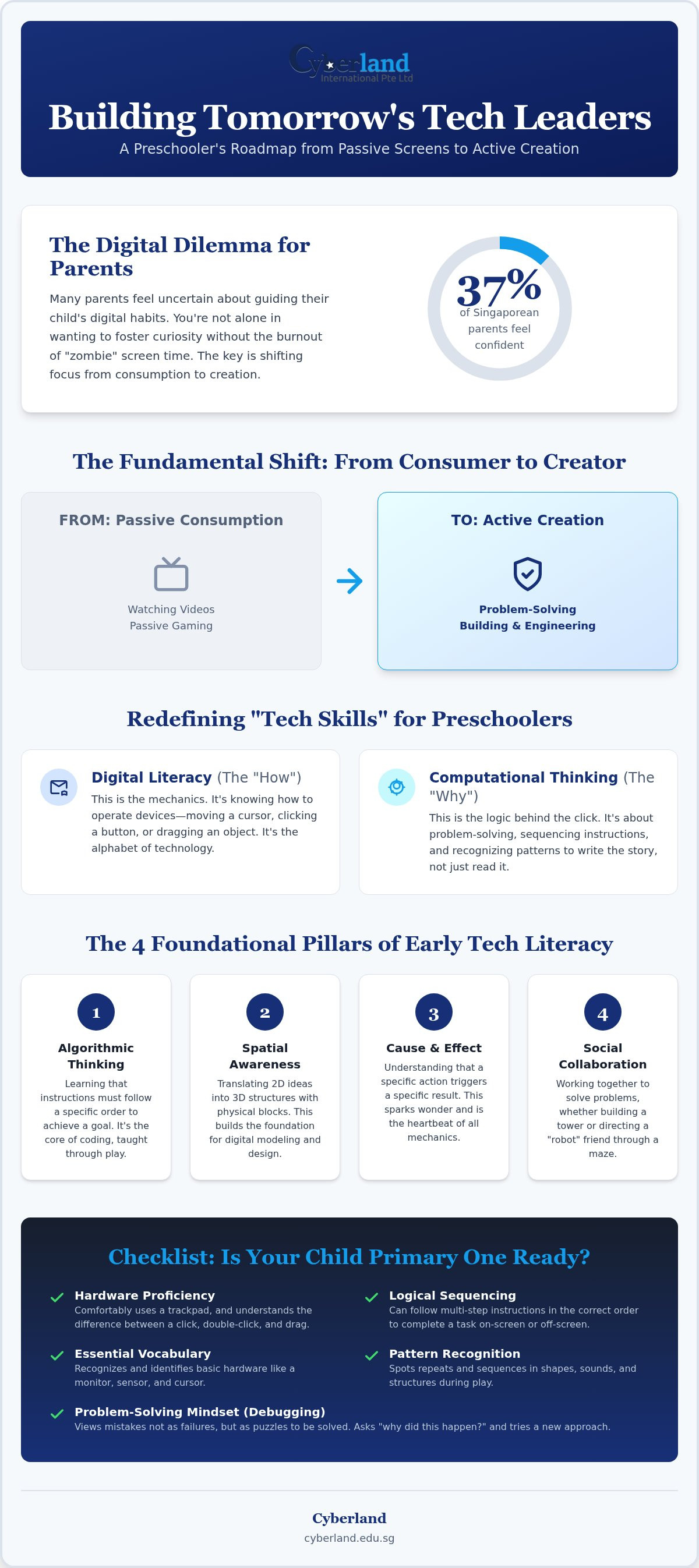
5 Essential Tech Skills Your Child Needs Before Primary One
Primary One is a milestone. It's a leap into a new world of discovery. In Singapore, technology is a key partner in that journey. Equipping your child with the right tech skills for preschoolers ensures they step into the classroom with a smile. These five essentials go beyond simple games. They build the confidence needed for the P1 computer lab and beyond.
Mouse and Trackpad Proficiency: Most P1 labs use desktops or laptops. Navigating a cursor requires different fine motor control than swiping a screen.
Basic Hardware Vocabulary: Knowing terms like CPU, monitor, and sensor helps them follow teacher instructions without confusion.
Logical Sequencing: The ability to order tasks to reach a goal is the "grammar" of both coding and daily life.
Digital Safety Basics: We introduce the concept of "private" versus "public" in a way that's easy to grasp.
Resilience in Problem Solving: When tech fails, we encourage a growth mindset. Fixing a "bug" is just part of the fun.
Preparing for the P1 Logic Curriculum
Logic is the secret ingredient in early math and science. Fostering critical thinking for early learners allows them to dismantle big problems into manageable, bite-sized tasks. They begin to see patterns in shapes and numbers. This mental agility is a superpower. It turns a daunting math problem into a playful puzzle. By identifying these patterns early, children feel more at home with the structured thinking required in Primary One.
Digital Citizenship for 5-Year-Olds
Digital citizenship starts early. It's about respect and safety. We teach five-year-olds to treat hardware with gentle hands. Simple internet rules, like asking permission before clicking, become second nature. We explain digital footprints using the analogy of footprints in the sand. What we do online leaves a mark. It's a nurturing way to build responsible habits before they go solo online. This foundation ensures they use technology as a force for good.
Ready to give your child a head start? Explore our Kindergarten Enrichment programs to see these essential skills come to life through play.
How Cyberland Sparks a Lifelong Love for Technology
At Cyberland, we believe every child is a natural-born innovator. Our philosophy is simple: nurture curiosity through hands-on discovery. We don't just teach tech skills for preschoolers; we ignite a passion for problem-solving. It's about giving them the freedom to explore, fail, and succeed in a supportive space. Real tools. Real results. Pure joy.
Our specialized modules are designed to match every developmental milestone. We focus on the "why" behind the "how." By transforming complex concepts into playful challenges, we ensure that learning never feels like a chore. It's an adventure that builds a rock-solid foundation for the future. We offer three core pathways for young explorers:
Junior Engineer: Building the foundations of physical mechanics through tactile construction.
Junior Programmer: Making coding logic accessible and fun using intuitive, screen-light tools.
STEMtastic Workshops: Providing integrated learning experiences that blend science, tech, and creativity.
A Nurturing Environment for Young Minds
Growth requires the right atmosphere. We keep our group sizes small to ensure every child receives expert mentorship and personalized attention. It's an uplifting and encouraging space where every question is celebrated. Our location in Ang Mo Kio Industrial Park 2 serves as a vibrant hub for young innovators across Singapore. We provide the high-quality equipment. They provide the boundless imagination. It's a partnership built on trust and a shared vision for success.
Partnering with Parents and Schools
We believe in a holistic approach to early education. Cyberland is proud to have partnered with multiple Singapore preschools and primary schools to bridge the gap between early play and Primary One logic. We support the national curriculum through robotics workshops for primary schools Singapore parents and educators trust. These collaborations ensure that the skills learned in our center align perfectly with classroom goals.
The journey doesn't end when the workshop finishes. We provide practical resources for parents to continue the exploration at home. Building tech skills for preschoolers is a collaborative effort between the center, the school, and the family. It starts with a single spark of interest. Take the first step today by joining a Cyberland workshop. Watch your child's confidence reach new heights as they master the tools of tomorrow. Let's build the future together, one block at a time.
Building Your Child's Digital Superpowers
The journey toward Primary One doesn't have to be filled with digital anxiety. By focusing on computational thinking and hands-on engineering, you're giving your child a head start that lasts a lifetime. We've explored how tech skills for preschoolers are rooted in logic and spatial awareness rather than passive screen time. These foundations turn curious play into purposeful discovery.
As a trusted partner of Singapore preschools, Cyberland provides the perfect bridge between early wonder and academic logic. Our hands-on, screen-light curriculum is led by expert mentors in STEM and Robotics who understand how young minds grow. Whether it's mastering the "Active Learning" rule or building resilience through debugging, every moment in our workshops is a step toward confidence.
Your child has the potential to be a bold innovator. Let's nurture that spark together and watch them shine in the digital world.
Frequently Asked Questions
At what age should my child start learning tech skills?
Age 4 is the perfect time to begin. At this stage, children are naturally curious and ready to explore foundational logic. Our Nursery Enrichment workshops introduce tech skills for preschoolers through play-based discovery. We focus on sparking interest rather than formal academic pressure. Starting early builds a positive relationship with technology. It ensures they see tools as things to create with, not just consume.
Will learning to code so early cause eye strain or screen addiction?
Not if the curriculum is designed for hands-on, screen-light learning. We prioritize physical movement and tangible tools over passive tablet use. This approach follows the spirit of Singapore's 2026 ECDA guidelines. By focusing on active creation, we minimize the risk of eye strain or digital addiction. Your child stays engaged with the physical world while developing the mental logic needed for the digital one.
How do tech skills help with Primary One preparation in Singapore?
These skills bridge the gap between preschool play and the P1 logic curriculum. Primary One students in Singapore encounter structured math and science that require sequencing and pattern recognition. Learning to navigate a trackpad or mouse also prepares them for computer lab sessions. Most importantly, it builds the "can-do" attitude needed for new academic challenges. They enter the classroom feeling confident and ready to solve puzzles.
What is the difference between Cyberland’s Junior Engineer and Junior Programmer?
Junior Engineer focuses on physical mechanics and spatial awareness. Children build structures to understand how things work in the 3D world. Junior Programmer emphasizes foundational coding logic and sequencing. While one is about the "body" of technology, the other is about the "brain." Both programs use hands-on tools to make complex concepts accessible. They work together to create a well-rounded understanding of modern technology.
Do I need to buy expensive equipment for my child to learn tech at home?
You don't need fancy gadgets to start. Simple building blocks, puzzles, and logic games are excellent for reinforcing tech skills for preschoolers at home. We provide all the specialized robotics kits and hardware during our workshops in Ang Mo Kio. This allows your child to explore high-quality tools without you needing to invest in expensive equipment. Focus on encouraging their curiosity and let us handle the technical gear.
How can I tell if a tech enrichment program is high quality?
Look for a program that emphasizes creation over consumption. High-quality centers offer small group sizes and expert mentorship. Check if they are a trusted partner of Singapore preschools and primary schools. A good program should have a clear educational arc. It must focus on developmental milestones rather than just playing with robots. Ask about their philosophy on hands-on, tactile learning and their experience with young learners.
Can tech skills really be taught without a computer screen?
Absolutely. Technology is a way of thinking, not just a device. We teach coding logic through physical mazes and sequencing games that don't require a single monitor. Tangible robotics allow kids to feel the logic as they connect parts. This screen-light approach is vital for young learners. It builds the mental architecture of a programmer while keeping them physically active and socially engaged with their peers.
What are the most important 'soft skills' learned through technology?
Resilience is perhaps the most vital soft skill. When a project doesn't work, children learn to debug the problem rather than giving up. They also develop collaboration skills by working on STEMtastic workshops with friends. Technology encourages precise communication and critical thinking. These traits are universal. They help children thrive in any environment, from the playground to the future workforce. Curiosity becomes their greatest superpower.


Comments