
Technology Education for Young Learners: 2026 Trends in Singapore
- Daniel Chua
- Aug 13
- 11 min read

Updated: Aug 15
What if the most powerful tool for your child’s future isn't a tablet, but their own ability to solve problems? In 2026, technology education for young learners in Singapore has shifted. It's no longer just about clicking buttons. It's about building bridges. We know you want the best for your little one. You might worry about excessive screen time or feel confused by jargon like "computational thinking." It's natural to fear your child could fall behind in our fast-paced, tech-driven economy.
We’re here to guide you through this exciting transition. Discover how 2026’s evolving tech landscape is transforming early childhood education from passive consumption to active innovation. This article provides a clear roadmap for healthy tech exposure that prioritizes growth. We’ll explore how to strike a perfect balance between digital tools and physical play. You'll also gain a better understanding of how to prepare for Primary One logic requirements using hands-on modules like Junior Programmer and STEMtastic. Let’s turn screen time into "build time" and spark a lifelong love for discovery.
Table of Contents
The Evolution of Technology Education for Young Learners in 2026
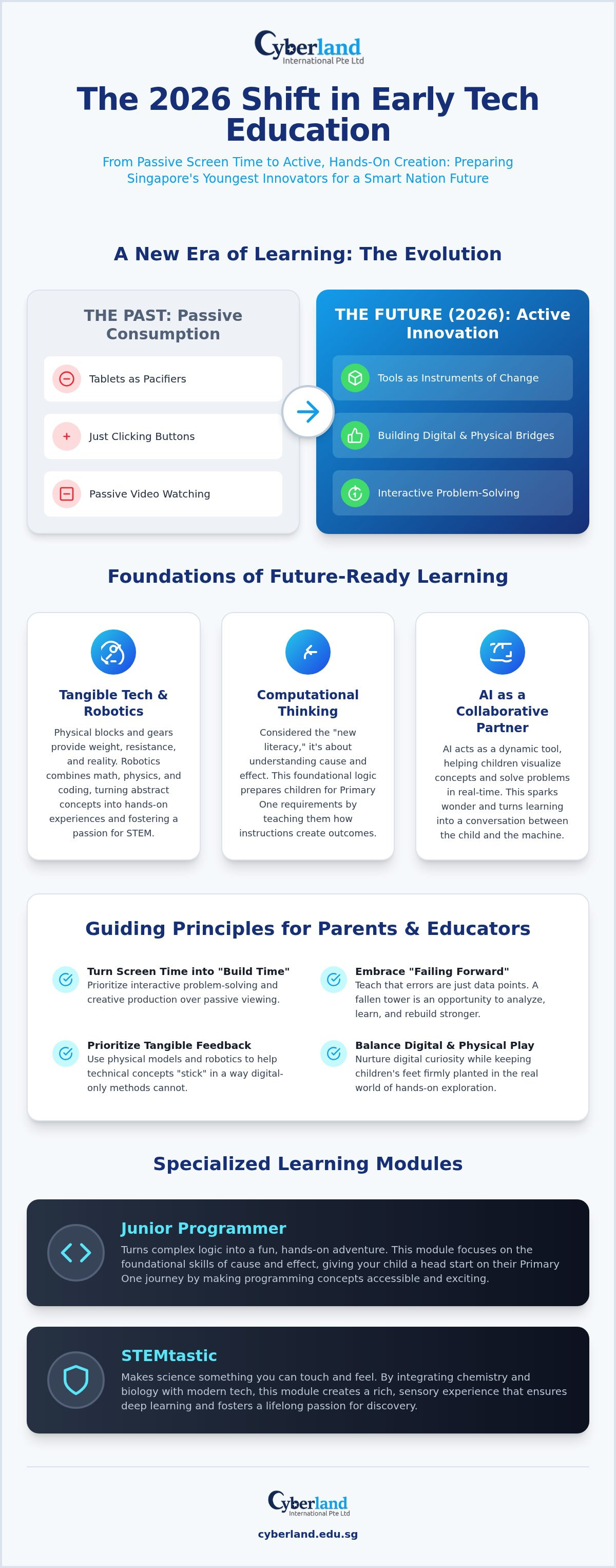
In 2026, technology education for young learners has moved far beyond the glow of a screen. It isn't just about knowing how to swipe or click. Instead, it's about understanding the "why" and "how" behind the digital world. We see technology as a canvas for creativity. It's a way for children as young as four to build, test, and refine their ideas. This shift focuses on active, creative production rather than passive consumption. We're moving away from tablets as pacifiers and toward tools as instruments of change.
As these young learners grow into savvy digital citizens, understanding the evolution of the platforms they use becomes essential; for instance, indiecollaborates.com explains how significant changes in interface features like swipe-up links can impact digital engagement strategies.
Being future-ready starts with foundational logic. By age four, children are beginning to grasp cause and effect. They're ready to explore how instructions create outcomes. In this new era, AI acts as a collaborative partner. It's a tool that helps children visualize concepts and solve problems in real-time. This partnership sparks a sense of wonder. It turns learning into a dynamic conversation between the child and the machine. They learn that errors are just data points; this resilience is the bedrock of engineering and innovation.
From Screen Time to Innovation Time
Passive video watching is a thing of the past. Today's classrooms prioritize interactive problem-solving. We're integrating "AI-first" thinking, where children learn to prompt, experiment, and iterate. This modern approach to educational technology treats the digital space as a laboratory. We define technology education as a mindset of inquiry rather than a set of tools. It's about asking the right questions. When children see themselves as innovators, they gain the confidence to tackle any challenge. They move from being users to being creators in a world they help design.
The Singapore Context: Smart Nation Kids
Singapore’s educational landscape is rapidly adapting to the 2026 roadmap. The Ministry of Education is carefully phasing AI into schools, ensuring students learn with "pedagogical guardrails." While formal AI tools are introduced later in primary school, the foundation is built much earlier. This is where STEM enrichment programs in Singapore play a vital role. They bridge the gap between school curriculum and future-ready skills. We believe in balancing academic rigour with the pure joy of discovery. It's about preparing children for a Smart Nation while keeping the magic of childhood alive. Every experiment is a step toward a brighter, more confident future for our kids.
Tangible Tech: The Rise of Robotics and Physical Engineering
Build. Break. Rebuild. For a child, these are the first steps of engineering. While screens offer pixels, physical blocks and gears offer weight, resistance, and reality. This is the heart of technology education for young learners in 2026. It’s about "tangible tech." By manipulating 3D structures, children begin to understand the invisible 2D logic that powers our world. Robotics serves as the ultimate multi-disciplinary tool. It combines math, physics, and coding into one exciting package. When a child sees a motor turn because of a command they built, sparks of interest ignite. These hands-on workshops do more than teach skills; they foster a lifelong passion for STEM.
Nurturing Young Innovators: The Junior Engineer Approach
Simple machines are the best teachers. A lever or a pulley isn't just a toy; it’s a lesson in force and motion. In our junior engineer program for kids, we focus on this mechanical foundation. Building physical models helps bridge the gap between abstract concepts and cognitive development. It’s about spatial awareness and fine motor skills. There’s also a deep emotional benefit here. When a tower falls, it’s not a mistake. It’s an opportunity to "fail forward." Children learn to analyze why it collapsed and try again. This resilience is what separates a student who uses tech from one who masters it.
STEMtastic Learning: Making Science Tangible
Science shouldn't be confined to a textbook. We believe in making it something you can touch and feel. By integrating chemistry and biology with modern tech, we create a rich, sensory experience. Research into EdTech in Early Childhood Education shows that tactile feedback is crucial for deep learning. It helps technical concepts "stick" in a way that digital-only methods cannot. This is why engaging STEM workshops for schools are now a staple in Singapore. They turn the classroom into a vibrant laboratory of discovery. Whether it's testing a circuit or observing a chemical reaction, the goal is the same. We want to ignite curiosity. If you're looking to bring this energy to your child's learning, exploring our Junior Engineer modules is a wonderful place to start.
Computational Thinking: The New Literacy for 2026
Computational thinking is the secret ingredient in technology education for young learners. It isn't just about computers; it’s about how we think. Before a child even enters Primary One, they can learn to solve complex puzzles by breaking them into smaller, manageable pieces. This is called decomposition. We also teach pattern recognition, helping them spot similarities in different situations. Finally, algorithmic thinking gives them the power to create step-by-step instructions. These skills form the "grammar" of the future. They provide a solid foundation for every subject, from math to creative writing.
You don't always need a screen to learn these concepts. "Unplugged coding" uses physical games and cards to build logic. It’s a joyful, active way to learn. By the time children move to block-based coding, the transition feels natural. They aren't just moving blocks on a screen. They're expressing logical thoughts they already understand. This approach ensures that technology education for young learners remains grounded in real-world play while building high-level cognitive skills.
Junior Programmer: Coding as a Language
Think of coding as a second language. At age five, a child's brain is like a sponge. Learning to "speak" code is just as natural as learning English or Mandarin. Enrolling your child in a junior programmer course in Singapore provides a structured environment for this growth. It prepares them for the logic-heavy requirements of the Primary One curriculum. They gain confidence. They learn that a "bug" is just a puzzle to be solved. This mindset is invaluable as they grow. It turns frustration into a quest for discovery.
AI Literacy for Preschoolers
AI is everywhere, but it doesn't have to be a mystery. We help children understand how machines "learn" through examples. It’s about demystifying the magic. We also focus on the human element. Ethics and safety are vital parts of the conversation. Our goal is to align with Singapore's EdTech Masterplan 2030, which emphasizes digital literacy from a young age. By 2026, AI literacy will be as fundamental as basic numeracy in early childhood education. We want our children to be wise users and ethical creators. This ensures they stay ahead while staying safe in a tech-driven world.
Strategies for Parents and Educators to Foster Tech Curiosity
Curious minds are built through purposeful play. You don't need a screen to foster a love for discovery. In fact, the most effective technology education for young learners often begins with a cardboard box and a bold question. As parents and educators, our role is to act as guides. Encourage your child to ask "why" things work. How does a door hinge move? Why does water swirl down the drain? You can even explore Digital Door Locks together to see how electronic sensors and mechanical parts work in tandem. These moments of inquiry are the seeds of engineering. By validating their curiosity, you show them that the world is a puzzle waiting to be solved. It’s about building a mindset that sees possibilities where others see problems.
Choosing the Right Enrichment Partner
Classrooms in Singapore are evolving rapidly. When looking for STEM programs for schools in Singapore, look for programs that prioritize physical engagement over digital drills. Small class sizes are essential. They ensure every child gets the attention they need to experiment with gears, circuits, and motors safely. Specialist partners like Cyberland bring expert knowledge and high-quality materials directly to students. This collaboration bridges the gap between theoretical lessons and practical, joyful application. It turns a standard school day into an adventure in innovation. Educators should look for partners who understand developmental milestones and can translate complex logic into age-appropriate fun.
Igniting STEM Interest at Home
Learning doesn't stop at the school gate. You can easily ignite interest in STEM using everyday household items. Build a sturdy bridge out of dry pasta and tape. Create a "coding circuit" using string to map out a path of instructions for a toy. These activities reinforce the logic of technology education for young learners without increasing screen time. When you do use devices, try using them as creative tools for documentation. Have your child take photos of their LEGO builds to create a digital project journal. This helps them see technology as a way to share their physical accomplishments. It’s a wonderful way to set healthy boundaries while encouraging digital exploration.
Ready to see these trends in action? Explore our Junior Engineer and Programmer modules to find the perfect fit for your child’s development.
Cyberland: Leading the Way in Technology Education
At Cyberland, we believe every child is a natural-born innovator. Our philosophy is simple. We nurture creativity and curiosity through technology. We don't just teach kids how to use tools; we teach them how to think. This is the heart of technology education for young learners. Our hub in Ang Mo Kio Industrial Park 2 serves as a vibrant center for innovation. Here, we bring the 2026 curriculum to life through interactive workshops and hands-on modules. We see ourselves as the bridge between school subjects and future-ready skills. Every session is an invitation to explore, build, and dream.
We offer specialized pathways tailored to different developmental stages. Our Junior Engineer module lets kids build 3D structures to understand mechanical logic. In the Junior Programmer module, children learn to "speak" the language of code through playful interaction. For those who love a bit of everything, STEMtastic combines science and tech in one high-energy experience. These programs are practical implementations of 2026 trends. They ensure our students are always one step ahead. We don't just prepare them for the next grade; we prepare them for the next decade. Our goal is to ignite a spark that stays with them forever.
A Nurturing Environment for Growth
We provide more than just technical training. Our environment is professional yet warm. We are committed to guidance that feels supportive and encouraging. We balance technical skills with character development, such as resilience and teamwork. Singapore schools and parents often tell us how our workshops bridge the gap between school curriculum and real-world skills. It's about building confidence alongside competence. We focus on the joy of discovery. This optimistic approach helps children see challenges as puzzles. They learn to love the process of finding solutions. Our mentors are experts who deeply understand child psychology and milestones.
Join the Innovation Journey
The journey toward a tech-ready future is a collaborative one. We partner with preschools and primary schools across Singapore to deliver specialized workshops. These sessions are designed to fit seamlessly into the 2026 educational roadmap. We are now opening enrollment for our upcoming 2026 enrichment cycles. Whether you are an educator looking for school modules or a parent seeking nursery and kindergarten enrichment, we invite you to be part of this transformation. Our mission is to ignite a lifelong passion for growth. Let's work together to give the next generation the tools they need to succeed. Contact Cyberland to ignite your child’s tech journey today!
Igniting a Future of Boundless Possibility
The journey into 2026 is an invitation to dream. We've moved beyond simple screens to a world where our children are the architects of their own digital adventures. By prioritizing active creation over passive scrolling, we're giving them more than just technical skills. We're giving them a voice. The shift toward tangible engineering and computational logic ensures that technology education for young learners remains grounded in play while reaching for the stars. It's about nurturing the confidence to solve problems before they even arise. Every challenge becomes an opportunity for growth.
As a trusted partner for Singapore preschools and primary schools, Cyberland is here to guide your family. Our expert-led workshops in Ang Mo Kio provide the perfect space for discovery. Through specialized Junior Engineer and Junior Programmer modules, we turn complex concepts into joyful milestones. We invite you to be part of this transformation. Let's work together to build a generation that doesn't just use technology, but masters it with heart and curiosity. Empower your child with 2026’s essential tech skills at Cyberland. Your child’s brilliant future starts with a single spark of wonder today.
Frequently Asked Questions
Is my 4-year-old too young for technology education?
No, age four is a wonderful time to start because technology education for young learners focuses on foundational logic and play. At this stage, we prioritize "unplugged" activities that build spatial awareness and cause-and-effect reasoning. It's about igniting curiosity through physical movement and building blocks. This early exposure helps children see themselves as creators from the very beginning. We turn complex ideas into simple, joyful discoveries that match their developmental milestones.
What is the difference between coding and computational thinking?
Computational thinking is the problem-solving process, while coding is the tool used to express those solutions. Think of computational thinking as the logic behind a story and coding as the language used to write it down. We teach children how to break down complex tasks into smaller, manageable steps. This structured mindset is a core part of technology education for young learners and applies to all areas of learning, including math and literacy.
How does Cyberland ensure technology education is safe for young learners?
We ensure safety by prioritizing hands-on, physical engagement and using age-appropriate materials under expert supervision. Our workshops focus on tactile learning with blocks and gears rather than unrestricted internet access. We create a nurturing environment where children feel secure to experiment and "fail forward." Every session is guided by mentors who deeply understand child development and safety protocols. This ensures that every tech adventure is both secure and inspiring for your little one.
Can technology education improve my child’s performance in Primary School?
Yes, it builds the logical reasoning and resilience required for the Primary One curriculum. Many parents find that children who engage in structured tech programs develop better focus and pattern recognition skills. These qualities are essential for subjects like Mathematics and Science. By mastering logic early, your child enters primary school with the confidence to tackle new academic challenges. They learn to view every mistake as a puzzle to be solved.
What kind of workshops does Cyberland offer for Singapore primary schools?
We offer specialized modules including Junior Engineer, Junior Programmer, and STEMtastic for primary schools across Singapore. These workshops are designed to align with the latest educational roadmaps and future-ready skills. We partner with schools to provide interactive, high-energy sessions that bridge the gap between textbooks and real-world application. Our modules are tailored to fit various age groups. They turn the classroom into a laboratory of discovery and innovation.
How do I balance screen time with hands-on engineering activities?
The best way to balance screen time is to use digital tools as a support for physical engineering activities. For example, your child can build a bridge with blocks and then use a tablet to document the process or research a design. We encourage a "tangible tech" approach where the digital element is just one part of a larger, physical project. This keeps the focus on sensory, real-world play while teaching healthy digital boundaries.
What are the key STEM trends for Singaporean students in 2026?
Key 2026 trends include the structured integration of AI, a focus on active innovation over passive use, and the rise of tangible robotics. Singapore's educational landscape is moving toward personalized learning through digital tools while maintaining strong pedagogical guardrails. There is also a significant push for schools to adopt digital management systems. These trends ensure that students learn with technology rather than just about it, preparing them for a truly digital future.
Does my child need prior tech experience to join the Junior Programmer course?
No prior experience is needed for your child to join our Junior Programmer course. We start with the basics of logic and sequence, making it accessible for absolute beginners. Our mentors guide every child through the journey at their own pace. We focus on turning complex coding concepts into a fun, language-based adventure that any five-year-old can enjoy. It's all about building confidence and a love for structured thinking from day one.


Comments