
The Building Blocks of Engineering for Kids: A Parent's Guide to Junior Innovation
- Daniel Chua
- Aug 9
- 11 min read

Updated: Aug 9
What if your child’s messy pile of plastic bricks is actually a blueprint for future innovation? It's easy to feel overwhelmed by rows of generic STEM toys that promise the world. You want to know if they're truly mastering the building blocks of engineering for kids or just making a mess. With Primary One logic requirements approaching, that uncertainty feels real. You aren't alone in wondering if everyday play is actually educational.
Table of Contents
What are the Building Blocks of Engineering for Kids?
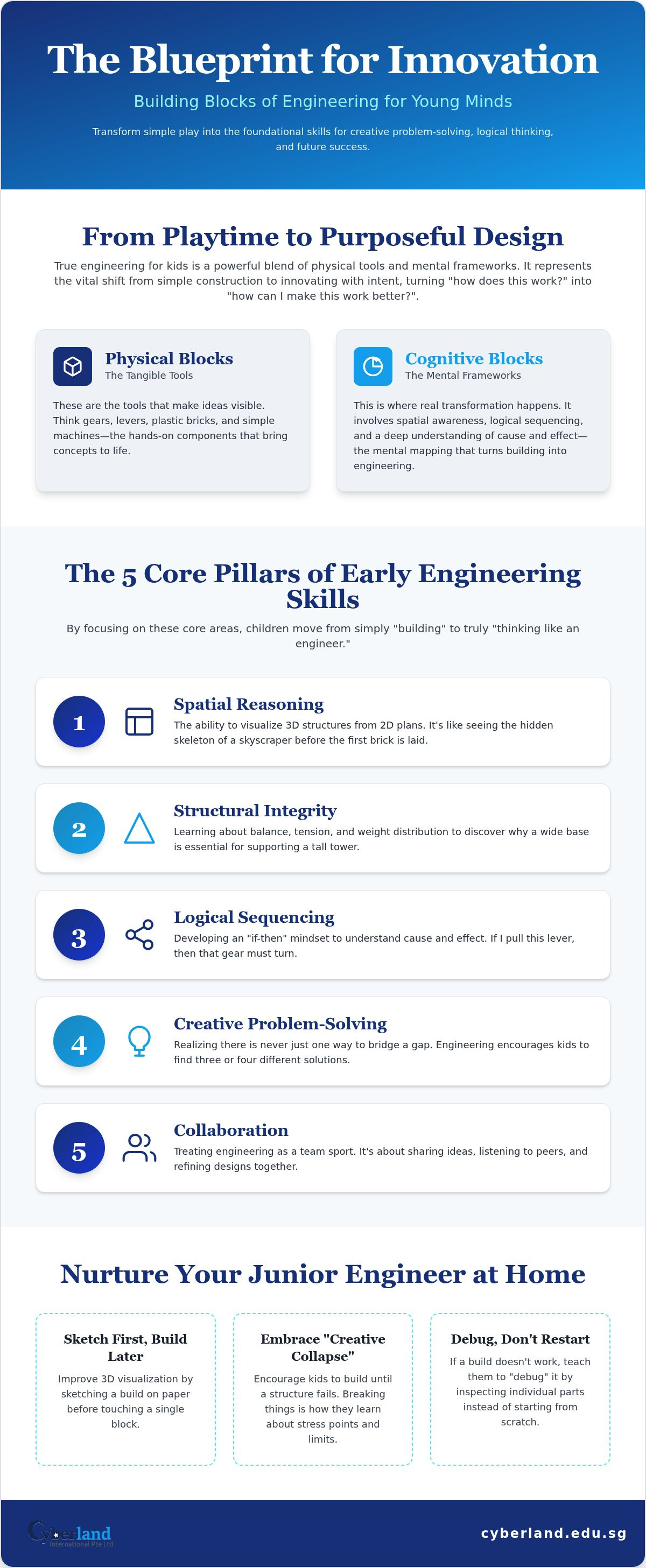
Engineering begins with a simple question: "How does this work?" For a child, it isn't about complex calculus or industrial blueprints. It's about the magic of discovery. It's the moment they realize that two triangles are sturdier than a square. We often think of the building blocks of engineering for kids as just physical toys. While plastic bricks and wooden sets are fantastic, they're only half the story. True engineering is a powerful blend of physical tools and mental frameworks. It represents a vital shift from simple construction to purposeful design.
Early exposure to these principles does more than teach mechanics. It shapes lifelong curiosity. When children learn to see the world as a series of systems, they become active creators rather than passive consumers. They stop just "playing" and start "innovating." This mindset is the foundation of Science, technology, engineering, and mathematics (STEM) education. It prepares them for a future where creative problem solving is the most valuable currency.
Physical vs. Cognitive Building Blocks
The physical side of engineering involves the tangible parts. Think of gears, levers, blocks, and simple machines. These are the tools that make ideas visible. However, the cognitive side is where the real transformation happens. This includes spatial awareness, logical sequencing, and a deep understanding of cause and effect. A child with a Junior Engineer mindset doesn't just snap pieces together. They visualize the 3D structure before they begin. They plan the sequence of assembly. They predict how moving one part will impact the rest. This mental mapping is what makes the building blocks of engineering for kids so effective for long term development.
The Role of Play in Technical Development
Play is the laboratory of the young mind. Unstructured play is essential for imagination. It lets kids explore without boundaries. But guided engineering challenges take this a step further. They introduce goals and constraints. This is where resilience is built. When a tower falls or a bridge snaps, it isn't a mistake. It's a data point. We encourage children to analyze why a structure failed. Was the base too narrow? Was the weight uneven? You can spark this interest at home using everyday objects like cardboard, tape, or even kitchen utensils. By turning "failed" structures into lessons, you help your child embrace the iterative process of real world innovation.
The 5 Core Pillars of Early Engineering Skills
Engineering isn't just about the final product. It's about the way a child thinks. These five pillars represent the true building blocks of engineering for kids. They transform a simple afternoon of play into a masterclass in innovation. By focusing on these core areas, we help children move from "just building" to "thinking like an engineer."
Spatial Reasoning: This is the ability to visualize 3D structures from a 2D plan. It's like seeing the hidden skeleton of a skyscraper before the first brick is laid.
Structural Integrity: Children learn about balance, tension, and weight distribution. They discover why a wide base supports a tall tower.
Logical Sequencing: This is the "if-then" mindset. If I pull this lever, then that gear must turn.
Creative Problem Solving: There is never just one way to bridge a gap. Engineering encourages kids to find three or four different solutions.
Collaboration: In our classrooms, engineering is a team sport. It’s about sharing ideas, listening to peers, and refining designs together.
According to NASA’s guide on What is an Engineer?, these professionals use their imagination and knowledge to design things that help people. This journey begins with simple curiosity and the right foundational skills.
Developing Spatial and Structural Awareness
Help your child improve 3D visualization by sketching their build on paper before they start. Testing limits is essential. We actually encourage kids to build to the point of collapse. Breaking things is part of the process; it teaches them exactly where the stress points are. You can introduce simple machines like pulleys and inclined planes using household items. This shows them how we can move heavy loads with less effort, making the building blocks of engineering for kids feel real and tangible.
Logic and Problem-Solving Frameworks
Great engineers break big problems into smaller, manageable "blocks." If a mechanical car won't roll, we don't start over from scratch. We "debug" the build. We check the axles. We inspect the wheels. We test the friction. This logical approach is a perfect bridge to our Junior Programmer courses. The same if-then thinking that fixes a physical gear is what powers digital code. It’s a seamless transition from physical structure to logical movement.
From Bricks to Bots: Comparing Engineering Tools
The right tool makes all the difference. For younger children aged 4 to 6, tactile tools are the essential starting point. There is no substitute for the weight of a physical brick in a child's hand. These physical building blocks of engineering for kids provide immediate sensory feedback. They learn about gravity and friction by touch. If a tower leans, they feel the imbalance. This hands-on foundation is what makes our STEMtastic approach so effective for early learners.
As they grow, the challenges must grow with them. We move from static structures to dynamic machines. Robotics kits bridge the gap between structure and movement. Suddenly, a bridge isn't just a bridge; it's a drawbridge powered by a motor. Digital blocks eventually enter the scene. These visual coding blocks mirror the physical ones they already know. It transforms a physical build into an interactive robot. Choosing the right tool depends on your child's developmental stage. We focus on matching the complexity of the tool to their growing cognitive reach.
The Evolution of Junior Engineer Modules
Our curriculum follows a purposeful path of discovery. Level 1 focuses on basic structures. Kids master balance and stability through simple construction. Level 2 introduces motion. We add gears, pulleys, and motors to the mix to create moving parts. Level 3 integrates simple sensors. Builds start to respond to light, sound, or touch. This progression ensures every child feels successful while staying challenged at our Ang Mo Kio center.
Transitioning to Junior Programmer Logic
Did you know building a tower is actually an algorithm? First, you clear the space. Then, you place the base. Next, you stack the layers. This logical sequence is the heart of coding. In our workshops, we show kids how visual coding blocks work just like physical building blocks of engineering for kids. You snap them together to create a result. It makes the transition to Junior Programmer logic feel natural. It isn't a leap; it's a step. We are preparing kids for the future of STEM in Singapore by showing them that code is just another way to build. This journey from physical bricks to digital bots ignites a passion for how the modern world works.
How to Foster Engineering Skills at Home: A 5-Step Guide
You don't need a high-tech lab to raise an innovator. Your living room is the perfect starting point for junior innovation. By using the right building blocks of engineering for kids, you can turn a rainy afternoon into a session of high-level thinking. This process mirrors the MOE's focus on critical thinking. It prepares your child for the logic requirements of Primary One while keeping the "fun" in foundational learning. Follow this simple 5-step guide to lead the way.
Step 1: Define the Challenge (The 'Ask' phase). Start with a specific problem. "Can you build a bridge that spans this gap between two chairs?" This sets a clear goal and provides a purpose for the build.
Step 2: Imagine and Plan (The 'Brainstorm' phase). Before touching a single block, ask them to draw their idea. Visualizing the structure on paper builds vital spatial reasoning.
Step 3: Create and Build (The 'Hands-on' phase). This is where the magic happens. Let them lead the construction. Your role is the "Junior Assistant" who provides materials on request.
Step 4: Test and Improve (The 'Iterate' phase). Does the bridge hold weight? If it collapses, celebrate! This is the moment they learn how to fix a weakness and strengthen their design.
Step 5: Share and Reflect (The 'Communication' phase). Ask them to explain how they solved the problem. Being able to articulate a solution is just as important as building it.
The Engineering Design Process for Kids
We simplify professional engineering workflows so they feel like a game. The goal is to create a "Try, Fail, Try Again" loop. This builds the grit needed for future success. Instead of giving answers, use questioning techniques. Ask, "What happens if we move this support to the middle?" or "Why do you think that side is leaning?" These prompts encourage children to analyze the building blocks of engineering for kids from a structural perspective. It shifts their focus from the final result to the process of discovery.
Engineering with Everyday Materials
Living in a Singapore apartment means being smart with space. You don't need a massive workshop. A simple "Maker Space" can be a plastic tub filled with upcycled treasures. Try the "Cardboard Challenge" using delivery boxes to create marble runs or towers. You can even use kitchen physics. Try building structures with spaghetti and marshmallows to teach tension and compression. These activities are budget friendly and highly effective for P1 preparation. Ready to take these home skills to the next level? Explore our Junior Engineer modules to see how we provide a structured environment for these foundational skills.
Building the Future at Cyberland: Junior Engineer & Beyond
Growth is a journey. At Cyberland, we make it an adventure. We believe that every child possesses an innate sense of wonder. Our mission is to nurture that curiosity through hands-on discovery. We don't just teach; we inspire. By providing the right building blocks of engineering for kids, we help them transform from curious builders into confident innovators. Our Junior Engineer modules are designed to be the spark that ignites a lifelong passion for how things work.
Located in the heart of Ang Mo Kio Industrial Park 2, our center serves as a vibrant hub for young minds. The Junior Engineer journey is a purposeful progression. It isn't just about finishing a project. It's about the "aha!" moments that happen along the way. Our STEMtastic workshops bridge the gap between classroom theory and real world application. We complement school learning by providing a space where kids can test, fail, and succeed in a supportive environment. They join a community of young innovators who share their excitement for discovery.
Why Choose Cyberland for Your Child?
Expert mentors make the difference. Our educators deeply understand child development and the unique milestones of every age group. We keep class sizes small. This ensures personalized guidance for every student. Your child isn't just a face in a crowd; they're a junior innovator with a unique perspective. Our curriculum is built for the long term. It grows with your child, offering a seamless pathway from Nursery enrichment all the way to Primary Six challenges. We provide the consistency and expertise needed to master the building blocks of engineering for kids at every stage.
Start Your Engineering Adventure Today
The best way to see the Cyberland difference is to experience it. We invite you to book a trial session at our Ang Mo Kio center. See the excitement on your child's face as they bring their first gear system to life. We also partner with schools across Singapore to bring high quality STEM experiences to every student. Whether at our center or in the classroom, we're committed to building the next generation of leaders. The future is waiting. Let's start building it together.
Ignite the Spark of Junior Innovation
Mastering the building blocks of engineering for kids is about more than just construction. It's about mindset. Every tower that falls is a lesson in resilience. Every bridge that stands is a victory in spatial reasoning. You've seen how simple play evolves into purposeful design through our five core pillars. From sturdy structures to the "if-then" logic of a Junior Programmer, these skills prepare your child for the logic requirements of Primary One and beyond.
Cyberland has provided specialized STEMtastic workshops since 2026. Our nurturing environment in Ang Mo Kio Industrial Park 2 is designed for explorers aged 4 to 12. We bridge the gap between physical bricks and complex problem solving. It's time to turn natural curiosity into a lifelong skill. Your child isn't just playing; they're preparing for a future of innovation. Every great engineer started with a single block and the right guidance.
Explore Junior Engineer Modules at Cyberland
The journey begins today. Let's build something amazing together.
Frequently Asked Questions
What is the best age to start engineering classes for kids?
Children can begin their journey as early as age 4. Our Junior Engineer modules are specifically designed for kids aged 4 to 12. At this stage, their minds are incredibly flexible and open to new ways of thinking. Starting early allows them to build a strong foundation of curiosity before they face more complex academic requirements in primary school.
How do building blocks help with my child's math skills?
Construction play introduces geometry, measurement, and spatial reasoning naturally. When children interact with the building blocks of engineering for kids, they are constantly calculating symmetry and estimating lengths. They learn to understand fractions and proportions through physical assembly. It turns abstract mathematical concepts into tangible, visible results that they can manipulate and master through play.
Does my child need to be good at science to enjoy engineering?
No prior science expertise is required to dive in. Engineering is actually the hands-on application that often sparks a brand new interest in scientific theory. We focus on the joy of discovery and the thrill of making things move. Many children find that science becomes much more approachable once they've seen it in action through their own mechanical builds.
How does engineering prepare preschoolers for Primary One logic?
Engineering develops the "if-then" mental framework essential for the Singapore primary school curriculum. By analyzing why a tower stands or why a gear turns, preschoolers build the critical thinking skills needed for P1. It fosters persistence and the ability to break down large problems into smaller steps. This logical approach is a vital survival skill for their first year of formal schooling.
What is the difference between Junior Engineer and Junior Programmer?
Junior Engineer focuses on the physical "body" of a machine using gears, levers, and structures. Junior Programmer moves into the digital "brain" using code to tell those machines what to do. Think of engineering as building the car and programming as the engine and steering. Both pathways complement each other perfectly to create a complete understanding of modern technology; to see these mechanical principles applied to real-world vehicles, you can visit Carz World Pte Ltd.
Are there engineering workshops for schools in Singapore?
Yes, we actively partner with local schools to deliver our STEMtastic workshops directly in the classroom. These sessions are designed to support MOE learning goals through high energy, collaborative projects. We bring our specialized equipment and expert mentors to your school to ensure every student has the chance to experience the excitement of real world engineering challenges.
What materials do you use in the Junior Engineer modules?
We utilize a vibrant range of tactile tools, including specialized gears, motors, and high quality structural components. These building blocks of engineering for kids provide the immediate sensory feedback necessary to understand complex concepts like tension and weight distribution. Our materials are chosen to be safe, durable, and endlessly engaging for young hands and growing minds.
Can I help my child with engineering if I'm not an engineer?
You don't need a technical degree to be an inspiring mentor. Your most important role is to be a "curious guide" who asks open ended questions. Instead of providing answers, try asking "What happens if we move this support?" or "Why do you think it fell?" This encourages your child to lead the discovery process and builds their confidence as an independent problem solver.


Comments